Somerville Wood Flooring has handled wood flooring in Dorchester for more than 20 years, and some of the hardest calls we take arrive in the days after a heavy rain. A floor that was flat on Friday can be raised at the edges by Monday, and the owner standing on it wants to know whether it is ruined. Our first answer is nearly always the same: not yet, and do not decide yet.
Wet wood moves, and much of that movement reverses as the boards and the structure under them dry. Tearing out a floor that would have settled costs a household a floor it could have kept. Sanding one that is still wet costs more, because the boards keep moving after the finish goes on and the cup turns into a crown.
This page walks through how we handle a rain-soaked floor in an older Dorchester house: where the water tends to come from, how we read the wood while it dries, and how we repair and refinish once the numbers say the floor has settled. Every step is written down room by room, which matters when an insurance adjuster is involved.
When the Neponset Rises: March 2010 in Dorchester
Dorchester’s southern edge runs along the Neponset River, with Lower Mills sitting right on its bank. Most days the river is quiet, and the Dorchester Reporter called it normally placid in its coverage of March 14, 2010. That is part of why what happened that week caught so many households off guard.
Three Storms in a Row
The National Weather Service later summarized March 2010 plainly: record rainfall and record flooding affected southern New England that month. Its storm report describes three consecutive slow-moving low pressure systems, each one arriving on ground the last had already soaked. In the March 13-15 storm alone, as much as 7 to 10 inches of rain fell in a band from Methuen and Gloucester south through Plymouth and Brockton.
Those are regional figures, not a gauge reading from a Dorchester backyard, and we do not stretch them into one. What they explain is why so much water had nowhere to go by the middle of the month. Soil that is already saturated sends the next rain sideways, toward the lowest point it can find, and in an older house that is usually the basement.
Lower Mills and the Low Streets
According to the Dorchester Reporter, the Neponset rose dramatically after a nor’easter and flooded Lower Mills. Underpasses on Talbot and Morton streets went under, and so did the underpasses alongside the Franklin Park golf course. A firefighter at Ladder 29 on Blue Hill Avenue told the paper there were an awful lot of homes around there without heat, hot water and electricity.
That last detail is the one we think about on a floor job. A house without heat cannot dry itself, and a house without power cannot run a dehumidifier or a fan. Floors in homes that lost both sat wet longer than floors next door, and a longer soak changes what a board will do when it finally dries.
What That Week Means for a Floor Today
The paper gave no count of flooded Dorchester homes, and we will not invent one. The lesson is not that every house took water. It is that a heavy enough rain can put water into basements and first floors that have stayed dry for years, and the next storm does not have to set a record to do it.
Looking for wood-flooring closer to Stoneham? See Wood-Flooring Services in Stoneham.
Water in a Dorchester Basement or First Floor
Dorchester’s housing is old, and that shapes how a flood reaches a floor. Across the four ZIP codes that cover most of the neighborhood, Census survey figures count 30,800 of 58,234 housing units as built in 1939 or earlier, a little more than half. Floors in houses of that age were laid long before anyone planned for a finished basement below them.
Basement Floors and Finished Rooms
Many owners have since turned part of a basement into a family room, an office or a bedroom, often with a wood or engineered floor laid over a subfloor. That floor sits closest to the water and takes the first hit. An engineered wear layer soaked from beneath may begin to separate, and a solid hardwood floor fitted tight to a foundation wall usually buckles before it does anything else.
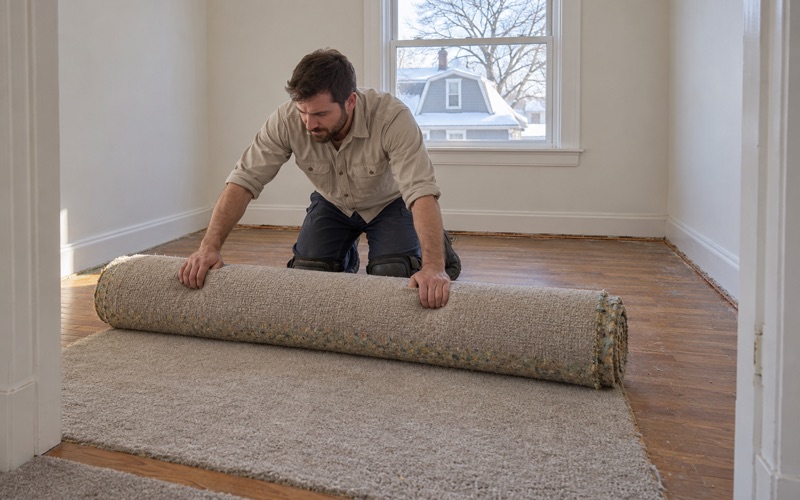
Carpet pad and tack strip hold water against wood for days, so we pull any wet carpet first. Whatever is under it gets a moisture reading before we form any opinion about whether it can be saved.
The First Floor Above
When water stands in a basement, the floor above it feels the effect even if no water ever crossed the threshold. Damp air rises through the joists and the subfloor, and red oak strip flooring laid over them starts to cup from the bottom. We often find a first floor reading high across a whole room while the surface looks only slightly dull.
Where water did come in at street level, it tends to pool along exterior walls and doorways and wick toward the middle of the room. Water stains around radiator pipes and along baseboards tell us where it sat longest, and those spots are where we take our first readings.
Old Finishes and What Lies Beneath
Older floors often carry a shellac finish or decades of wax residue, and both react to water differently than modern polyurethane. Shellac can turn white or cloudy where it stayed wet. Under some first floors we also find old resilient floor tile and black mastic from an earlier renovation, which we identify before anything is sanded and leave for the right trade.
Because most of these houses predate 1978, we also check the build year and any painted surfaces before sanding, since Massachusetts runs its own lead-safe renovation rules for homes of that age. Baseboards and shoe molding pulled after a flood often carry old paint, so that check happens early.
Will Cupped Boards Settle? Drying Before Deciding
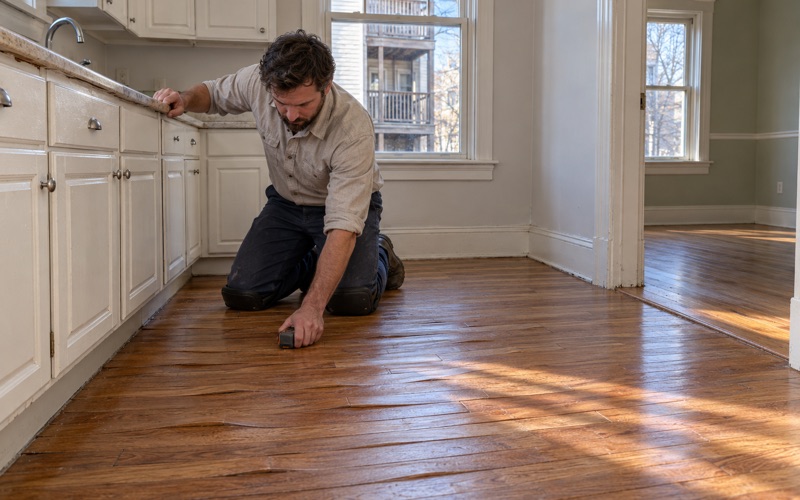
Cupping is the edges of each board standing higher than its center. It happens because the underside of the board has taken on more moisture than the top, so the bottom swells and pushes the edges up. In most rain floods the cause is water below the floor, and once the source is gone and the wood dries evenly, much of that cup can relax back down.
Reading the Wood, Not the Surface
We do not judge a flooded floor by eye. A moisture meter reads the boards in a grid across each room, and we take matching readings from the subfloor and from a dry room elsewhere in the house as a baseline. The floor is ready to assess when its readings come back close to that baseline, not when it simply looks flat.
We log every reading by room and date. For an owner with an open insurance claim, that log is the record an adjuster can follow, showing how wet the floor was, how long drying took and what was left once it finished.
How Long Drying Takes
There is no honest fixed answer. Fans and dehumidifiers running in a heated house bring a floor down far faster than a cold house with no power, like the ones the Ladder 29 firefighter described that March. Raising the heat and keeping air moving helps more than any product applied to the surface.
Season matters too. Wood that dries out in a heated winter house can open board gapping and winter gaps that close again by summer, and we factor that in before calling any gap permanent.
When a Floor Does Not Come Back
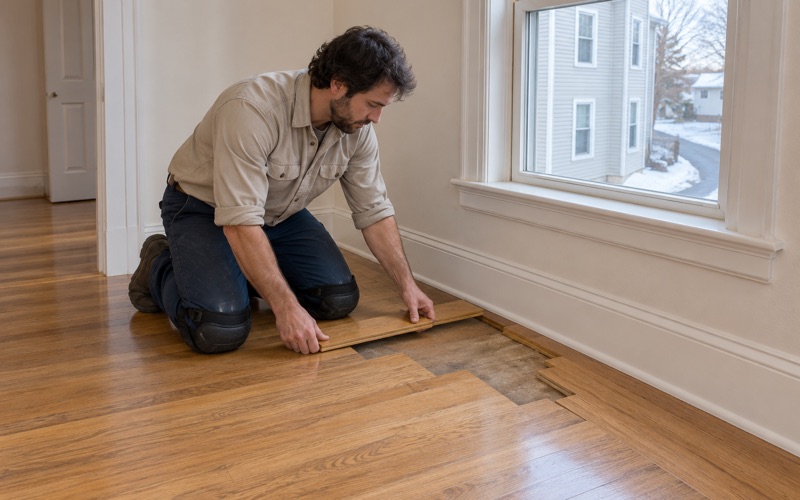
Some boards will not settle. Buckling, where the floor lifts off the subfloor entirely, usually means fasteners have let go, and those boards come out. Cupping that stays after the wood has fully dried, split tongue and groove joints, and boards gone black from sitting wet are signs that a section needs replacement rather than more waiting.
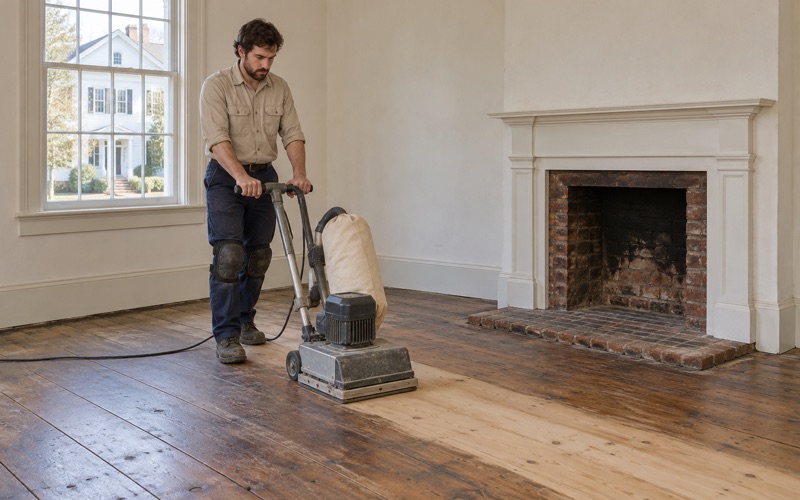
The mistake we see most is sanding too soon. Sand a cupped floor flat while it is still wet and the raised edges get cut down. When the board dries and the center comes back up, the floor crowns, and that cannot be undone without taking off more wood.
Repairing and Refinishing a Dorchester Floor After a Flood
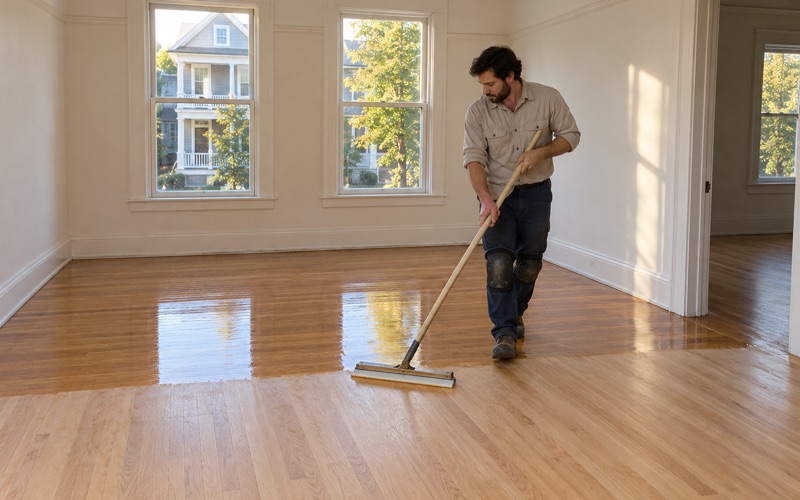
Once the readings hold steady, the work becomes ordinary floor work, done carefully. We start with the boards that need to come out, then decide whether the rest of the floor needs a full sanding or only a screen and recoat.
Board Replacement and Weave-In Repairs
Damaged boards come out individually, and new ones are woven into the existing floor so the joints stagger the way the original layout did. In older houses that can mean matching narrow red oak strip, eastern white pine or Douglas fir by width and grain. The same approach closes holes left where a damaged radiator or its pipes came out after the water.
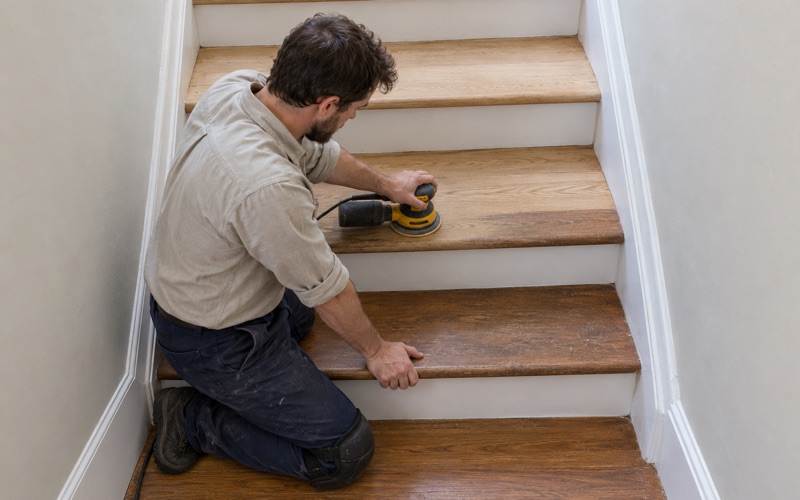
Before any sanding, we check how much wood remains above the tongue. Old pine and narrow strip floors refinished several times may not have much left, and a flood repair is not the moment to discover that halfway through a grit sequence.
Sanding and Finish After Water
A floor that settled well may still carry water stains that sit in the wood rather than the finish. Light ones often sand out, while dark ones that reached deep into the grain usually mean another board replacement. We lay stain and sheen samples on your own floor before a color is chosen, which matters when new boards have to blend with old ones.
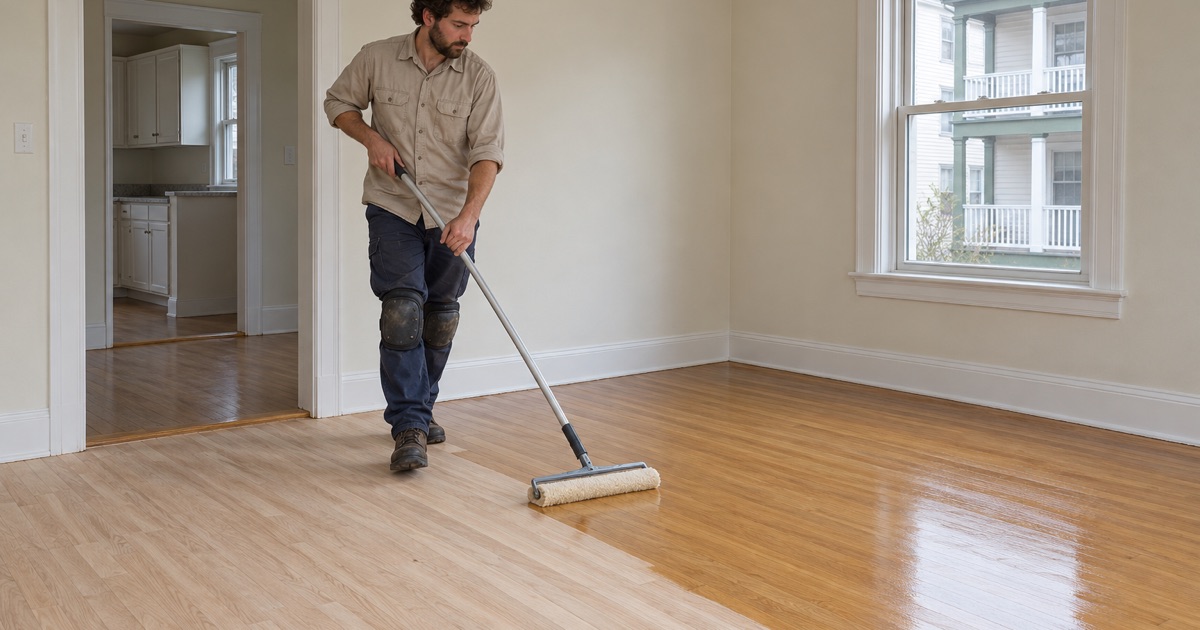
For the finish, we choose products that fit the Massachusetts VOC limits for wood coatings and plan fume and drying times around who is living in the house. A waterborne polyurethane gets a household back on the floor sooner, while an oil-modified polyurethane deepens the color of older wood more noticeably.
When More Than One Household Shares the House
When water reaches a house with more than one household, we can work one unit or one floor at a time so the others keep living there. Dust stays in the unit being worked on, with doors and returns sealed, and an itemized written estimate gives a landlord a clear record of what the water cost.
If the water came from the unit above rather than from the rain, we trace it, dry it and read it the same way, then document it room by room for the adjuster.
- 20+ Years With Wood Floors
- Written Itemized Estimates
- Free Estimates