Somerville Wood Flooring brings more than 20 years of experience to wood-flooring in Newton, and the first question on most of these jobs is not the stain color. It is the calendar. A full sand and refinish is loud, it runs over several days, and in Newton the loud part has to fit inside hours the city sets.
We plan the drum sander days first and fit everything else around them. Edging, sanding and buffing are the noisy stages; vacuuming, staining and the coats of finish are close to silent. Once the noisy stages are pinned to the right weekdays, the rest of the job usually falls into place, and the people next door know exactly when to expect the sound.
That matters most in a house you share with another household. Before the first board is sanded, everyone who will hear the work gets the dates in writing, and the sections below explain how we set those dates under Newton’s rules.
When Floor Sanding Can Happen in Newton

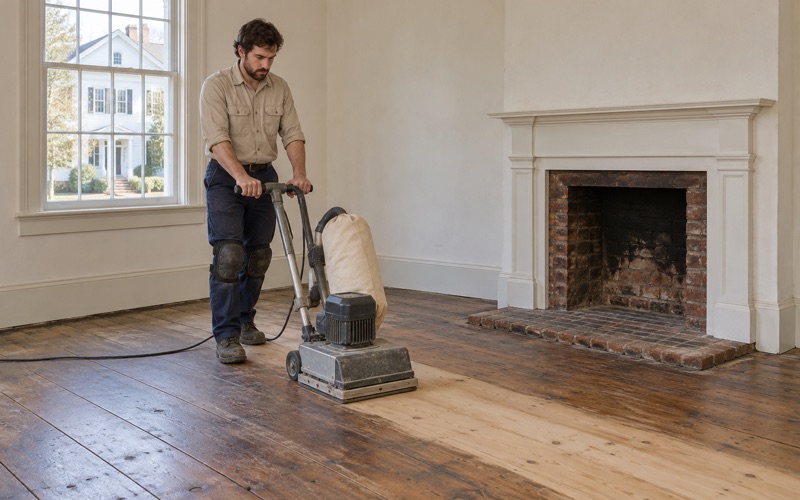
Newton’s noise rules sit in Section 20-13 of the city’s Revised Ordinances, and they do not leave floor work in a gray area. The ordinance defines construction to include the alteration or repair of a building using power hand tools. A drum sander, an edger and a buffer running on a living room floor are power tools altering a building, so the construction hours apply to them.
The same definition covers the saw that cuts a replacement board and the nailer that sets it, so patching follows the same clock as sanding. It also lists manual tools, so we keep hand scraping and board fitting inside the same hours rather than treating them as a way to stretch the day.
Weekday and Saturday Hours
Construction noise is allowed from 7:00 a.m. to 7:00 p.m. on weekdays and from 8:00 a.m. to 7:00 p.m. on Saturdays. We set our sanding days inside those windows and leave a margin at both ends, because loading in machines and rolling out paper makes noise of its own. A Monday-through-Saturday week gives us six usable days for the loud stages.
The Saturday start is an hour later than the weekday start, and that hour is easy to forget. On a Saturday job we arrive, carry equipment and set dust containment quietly, then start the first machine at 8:00 a.m. rather than at 7:00 a.m. Neighbors who expect a quiet Saturday morning notice the difference.
Sundays and Legal Holidays
Construction noise is prohibited at any hour on Sundays and legal holidays unless a permit has been issued. The ordinance lets the mayor or a designee grant one on a finding of undue hardship. A floor refinish that can move to Monday is not where we spend that request, so we do not run sanders on those days and build the schedule so nothing has to.
Holidays catch people out more than Sundays do. A Monday holiday turns a normal week into a five-day window that starts on Tuesday, and a job booked without checking the calendar can end up with its second sanding pass stranded. We check the holiday list when we book, not when we arrive.
Looking for wood-flooring closer to Forest Hills? See Wood-Flooring in Forest Hills.
What Newton’s Noise Ordinance Says About Sanders
Hours are only half of Section 20-13. The ordinance also sets maximum sound levels, and it names floor equipment directly: electric drills, sanders, saws other than chainsaws, and other power tools of all types are held to 75 dB(A).
Those limits apply whether the sander is in a basement playroom or a third-floor bedroom. What changes from house to house is how close the nearest lot line sits, how many windows face it and how much of the work is close to an exterior wall. Those three things shape the order we sand the rooms in.
Where the 75 dB(A) Is Measured
The limit is measured at 50 feet from the source or at the nearest lot line, whichever distance is less. On a deep suburban lot that may mean 50 feet from the machine; on a narrow lot, it means the property line, which can sit only a few steps from the room being sanded. We have no reading to quote for any given job, so we treat distance and containment as the things we can control.
Closing windows on the side facing the neighbor, taping plastic over the doorway and keeping doors shut between rooms all cut what reaches the lot line. None of that turns a sander into a quiet tool, and we do not promise a number. What it does is keep the sound inside the house as much as the house allows.
The Whine Limit and the Site Total
For tonal sound, which the ordinance describes as a whine, hum or buzz, the limit drops by 5 dB(A). The ordinance also caps cumulative construction noise on one site at 90 dB(A). That second figure is why we avoid stacking our sanding days on top of another trade’s loudest work, such as a kitchen crew cutting tile in the next room.
Violations carry a fine of up to $300 per offense, and each day counts as a separate offense. A three-day sanding job run past 7:00 p.m. every evening could count as three offenses, not one. We would rather finish a room the next morning than ask a client to carry that risk.
Sanding in a Newton Two-Family or Attached House
Newton has 5,277 units in two-unit buildings, 15.5 percent of its housing, and 2,785 renter households live in them. In a two-unit building the household that hears the sander may live directly above or below, sharing a stairway and often a basement. The 75 dB(A) limit is measured at the lot line or 50 feet out, but the household upstairs lives with the work all day.
One Unit at a Time
We refinish one unit or one floor at a time, so the other household keeps living in the building through the job. Before we start, we seal the doors, cover the returns and close off any shared ductwork in the unit we are sanding, then run HEPA vacuums at the end of each pass. The dust stays with the floor it came from.
The other household gets a breakdown of which days are loud, which are quiet and which are for curing finish. Shared hallway stairs and landings are done on their own dates, worked out with every unit that uses them, so nobody is shut out of the front door without warning. Common hallway stairs are quoted tread by tread, since a staircase is not priced by the square foot.
Attached Houses and Party Walls
Newton also has 2,576 one-unit attached houses, where the sound path is a party wall rather than a floor. In those homes we start the edger in the rooms farthest from the shared wall and work toward it, so the loudest close-in work happens in a shorter stretch. We tell the neighbor which morning the wall-side rooms are scheduled.
Where the building is a condominium, the association’s own notice and work-hour rules can be stricter than the city’s. We read them from the documents before booking, rather than assuming the city hours are the only ones that apply. When the two sets of rules differ, the narrower window is the one we schedule to.
Scheduling a Multi-Day Refinish Across a Newton Week
A full refinish on an older oak or pine floor usually runs several days from first sanding pass to the last coat, and only part of that is loud. With 48.8 percent of Newton’s housing built in 1939 or earlier, a floor may already have been sanded more than once, and we check how much wood remains above the tongue before deciding how hard the drum sander can work.
The plan below assumes one unit or one floor of connected rooms. Stairs add time of their own, because treads, risers and nosing are sanded with smaller tools and detailed by hand. Where the staircase is the only way up to a second unit, we give it its own short block of days so the household upstairs gives up access for the shortest stretch we can manage.
A Typical Monday-to-Saturday Plan
On a standard week we sand on Monday and Tuesday inside the weekday hours, with the coarse grit passes early and the finer passes and buffing later. Wednesday is for vacuuming, a tack pass and stain if the client chose one, far quieter work. Thursday and Friday carry the coats of finish, and Saturday stays open as a buffer.
Buffing between coats is a short, loud step, so it lands inside the same hours as sanding. The Saturday buffer matters because the later start shortens the day, and because any loud step that slips past Saturday waits until Monday. Building the slack in at the front is easier than explaining a gap to the neighbors later.
Finish Choice and Drying Time
The finish decides how long the household lives around the job. Waterborne polyurethane dries faster between coats and has a milder smell, which suits a house where another family is breathing the same stairwell air. Oil-modified polyurethane takes longer between coats and longer to cure, so it can push a job into a second week even when the sanding is done by Tuesday.
Every finish we use fits the Massachusetts VOC limits for wood coatings, and we lay stain and sheen samples on your own floor during the quiet midweek day rather than on a sanding day. That way the color decision does not hold up the loud work, and the loud work does not crowd the color decision.
Before Sanding Starts
Some checks happen before any machine is booked. We confirm the build year and look at painted baseboards and thresholds, because Massachusetts runs its own lead-safe renovation rules for homes built before 1978. We also look under carpet and in back rooms for old resilient tile and black mastic, and if we find them, that area goes to the right trade before our sanding days are set.
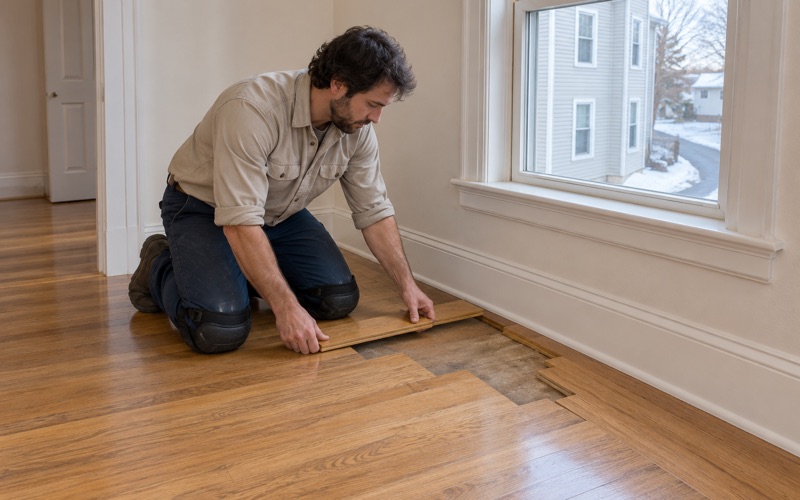
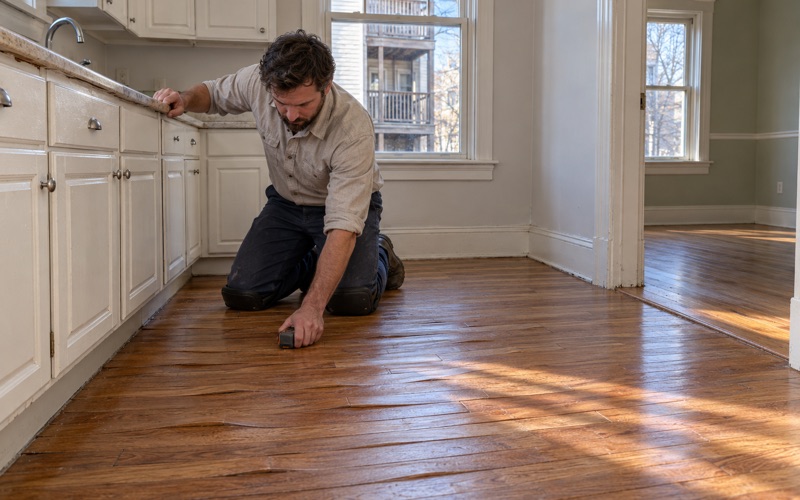
Patches come first too. Where a radiator, its pipes or an old wall came out, we weave new boards into the floor so the repair is sanded with everything else in the same loud days rather than adding a second round later. Water stains, pet urine stains and old wax residue are noted at the walkthrough, since some lift with sanding and some mean replacing boards.
- 20+ Years With Wood Floors
- Written Itemized Estimates
- Free Estimates