Somerville Wood Flooring brings more than 20 years of work to wood flooring in Stoneham, and much of what we are asked to do here is less about new boards than about old ones. An owner calls because the floor looks tired, then walks us through rooms where the trim, the doors and the stair rail all look like they did a century ago.
That changes the first question. In a newer house, the question is which floor to put down. In an older one with its detail still in place, the question is how much of what is already there can stay, and what it takes to make the parts that cannot stay disappear into the parts that can.
This page walks through how we approach that decision: where these houses are, what they tend to be built like, how we save and patch old boards, and when refinishing stops making sense and replacement starts. We give you the reasoning, so the call on your own floor is yours.
Stoneham’s Victorian Houses and the Shoe Trade That Built Them
The houses this page is about come from a particular stretch of the town’s history. Stoneham was a shoe town, and by 1891 it had 27 boot and shoe manufacturers. The money that trade brought in went partly into houses, and by 1915 the population had reached 7,489.
Where the Concentrations Are
In 1981 the Massachusetts Historical Commission’s reconnaissance survey of Stoneham found that the town retains a high proportion of well-detailed suburban Second Empire, Stick and Queen Anne houses, and that they survive with much of their original detailing intact. The survey names where they cluster: west of Main Street between Marble and Maple Streets, and east of William Street between Spring and Franklin Streets, with fewer along lower Main Street.
The same survey describes simpler Stock and Queen Anne cottages and houses, with a few mansard cottages, as dominant in the neighborhoods east of the center. Those homes are often just as old, and much of what follows applies to them too, at a smaller scale.
What the Housing Count Says
Census figures put the scale of it in plain numbers. Of Stoneham’s 10,196 housing units, 2,504 were built in 1939 or earlier, close to one in four. Not all of those are Victorian, since the town kept growing into the 1920s and 1930s, but the houses the survey describes are part of that count.
For an owner, that means your house is not a rare case. Old floors in houses like it have often been sanded, covered, patched and uncovered several times, and the way we read yours draws on that history.
Why the Detailing Matters to a Floor
The survey describes exteriors and styles, not floors, so we never assume what is underfoot until we have looked. What it does tell us is that these houses were built with care for detail, and owners who bought one usually did so because of that detail.
A floor that looks like it came from a different decade undercuts that. Our job is to keep the floor on the same side of the story as the trim, the windows and the stair.
Looking for wood-flooring closer to Jamaica Plain? See Jamaica Plain Wood-Flooring.
Saving the Original Floor in an Older Stoneham House
Before we talk about stain or finish, we work out what the floor is and how much life it has left. That starts with an inspection rather than a sample sanding pass, because a sander removes wood that cannot be put back.
Reading What Is Actually Down There
We lift a floor register or check a closet edge to see the species, the board width and how the boards are fastened, whether with cut nails, face nails or blind-nailed tongue and groove. Old pine and narrow red oak strip are both floors we work on often, but in your house we confirm the species rather than guess.
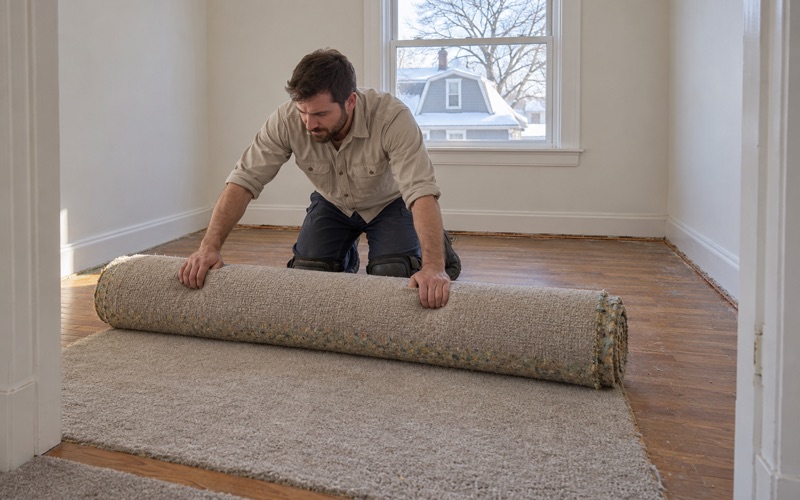
We also check whether there is a second floor laid over the first. Carpet pad and tack strip are the easy layers to spot; resilient floor tile and black mastic are the ones that change the plan, and when we find them we stop and leave that layer for the right trade before anything is sanded.
How Much Wood Is Left Above the Tongue
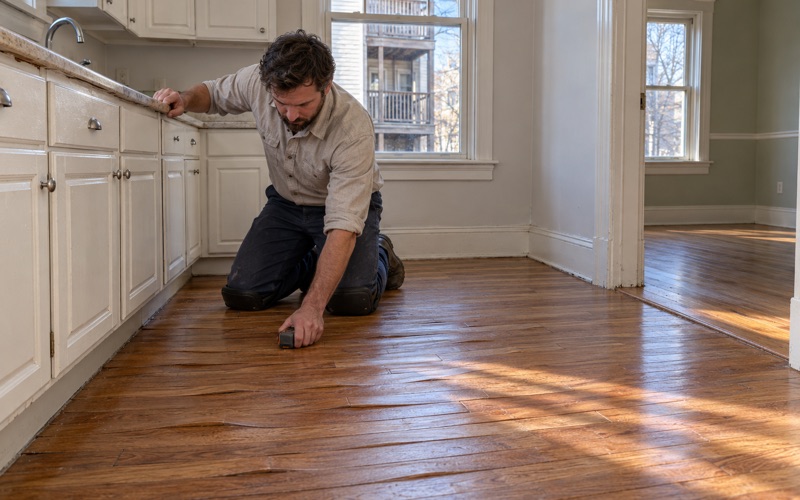
Every full sanding takes a little off the top of each board. On a floor that may have been sanded several times since it went in, the remaining wood above the tongue is what decides whether another pass is safe, so we check it at a pulled board or a threshold before we quote.
Where the wood is thin but the finish is still sound, a screen and recoat can buy years without cutting into the board. Where wax residue, shellac finish or peeling polyurethane is the problem, the approach changes, and we explain which approach your floor needs.
Lead Before Dust
Every one of these houses predates 1978, and painted baseboards, shoe molding and stair risers are common. Massachusetts runs its own lead-safe renovation rules for homes of that age, so we check the build year and any painted surfaces near the floor before a sander is turned on.
Dust containment comes next. We seal doors and returns in the rooms we are working in and use HEPA vacuums between grit passes, so the rest of the house, and its detail, stays out of it.
Patching Old Boards So the Repair Doesn’t Show
An old floor is rarely failing everywhere. It usually has a few bad spots: a gap where a radiator stood, a scar where a wall was moved, a doorway where a threshold came out. The quality of the patch decides whether the room reads as one floor.
Weaving In Rather Than Filling
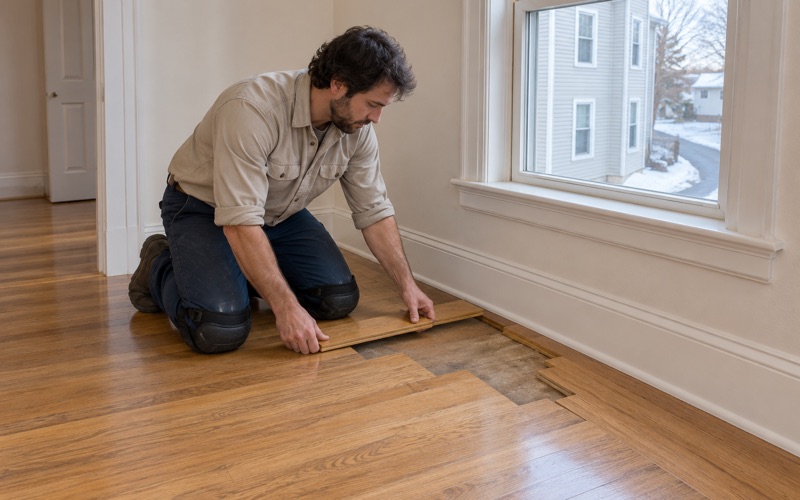
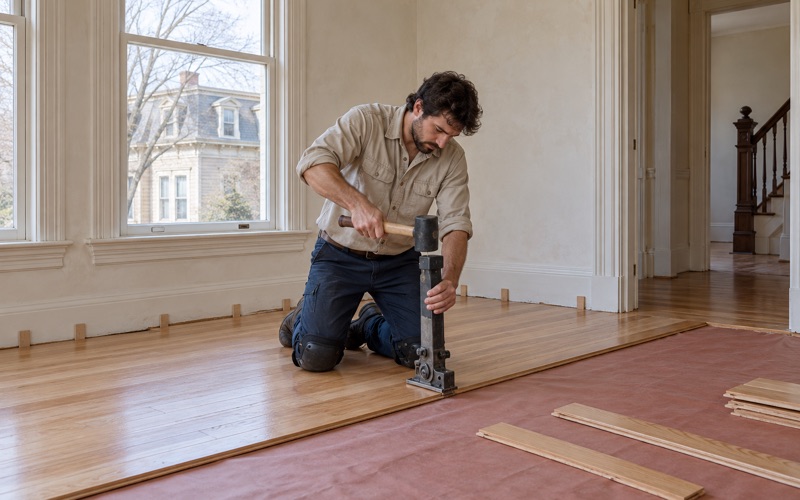
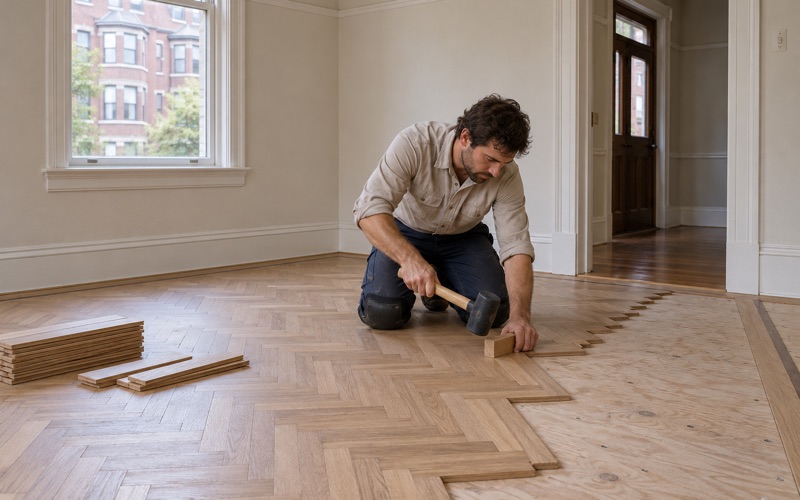
When a radiator, its pipes or a wall came out, we do not fill the hole with a square plug. We remove boards in a staggered pattern and weave replacement boards in, so the joints fall where the original layout would have put them and the repair has no outline.
The same applies to boards ruined by pet urine stains or deep water stains. A stain that has gone black into the grain rarely sands out, and board replacement is often a cleaner answer than chasing it with the sander.
Finding Boards That Match
New boards of the same species rarely match old ones on width, thickness or color. Where we can, we take matching stock from a closet or an area that will be covered, then fill that spot with new wood where nobody will see it.
When that is not possible, we match width and profile first, then let the full sanding and finish bring the color together. We lay stain and sheen samples on your own floor, next to the old boards, before a color is chosen.
Squeaks, Gaps and Pests
Old houses move. Squeaky floorboards and nail pops usually come from fasteners that have worked loose over the joist, and we refasten them before sanding so the fix is hidden under the new finish.
Winter gaps that close in summer are normal seasonal board gapping and are left alone. Exit holes and frass are different: they can point to powderpost beetle or old house borer activity, and we stop to show you what we found before any repair goes over it.
Refinish or Replace in a House That Still Has Its Details
With the inspection done and the patches planned, most owners come to the same fork. Some floors have one more good refinish in them. Others have reached the point where the honest advice is a new floor, laid to suit the house.
When Refinishing Is the Right Call
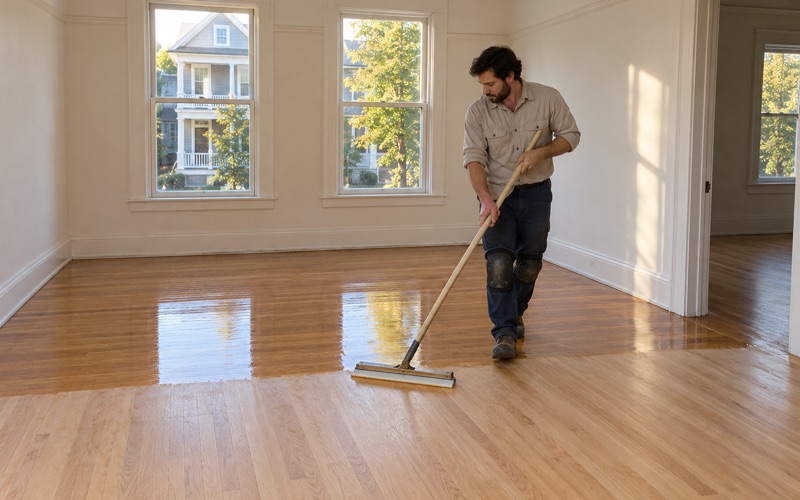
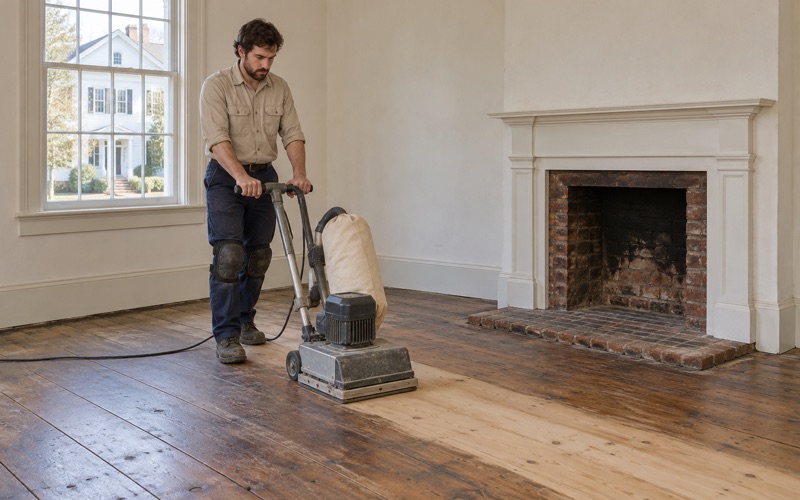
If the boards are sound, the wear layer is adequate and the damage is local, refinishing is almost always our recommendation. It keeps the wood already in the house, and once patched and finished, the floor suits the trim and doors around it in a way new wood takes years to match.
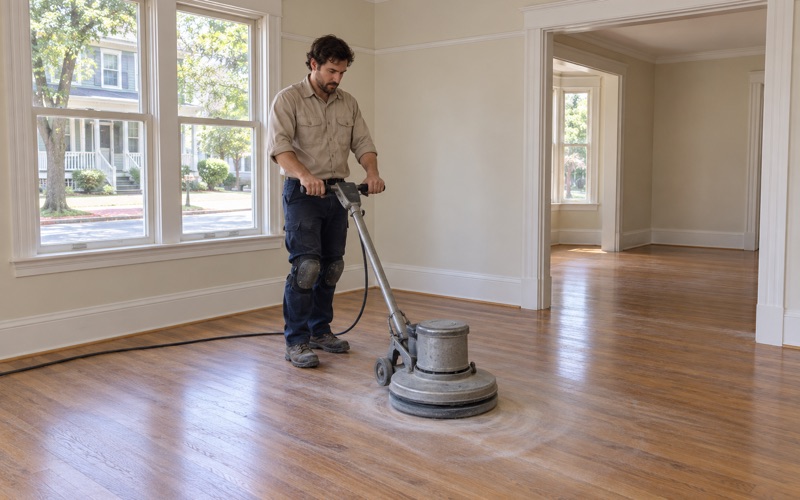
We plan the grit sequence for old wood, which often sands less evenly than new stock, running a drum sander through the field and an orbital sander for the final pass. Traffic lanes and rug shadow usually come out in the process.
When Replacement Makes More Sense
Some floors cannot be saved. Repeated sanding may have exposed the tongues, cupping or crowning may point to a moisture problem below, or past owners may have patched so much that little original wood remains.
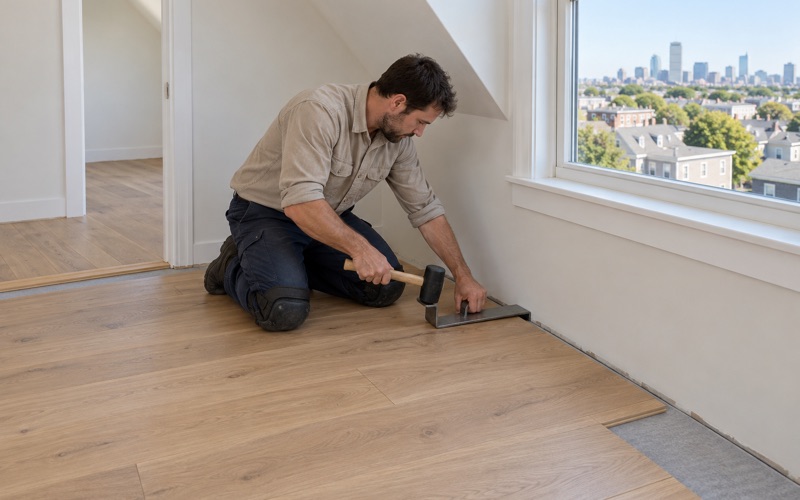
In those cases we talk through solid hardwood laid to match the board width of the existing floor, site-finished so the color can be tuned to the room. We avoid prefinished planks in rooms where a beveled edge would look out of place next to period trim.
Choosing a Finish for an Old Floor
Finish choice changes how old wood looks. Oil-modified polyurethane warms toward amber over time, waterborne polyurethane stays closer to the raw color, and hardwax oil gives a low, soft look some owners prefer in older rooms.
Whatever you choose, it has to fit the Massachusetts VOC limits for wood coatings. We plan drying and fume times around whoever is living in the house, and give you a written, itemized estimate that shows each room, each patch and the finish before work starts.
Stairs and Landings
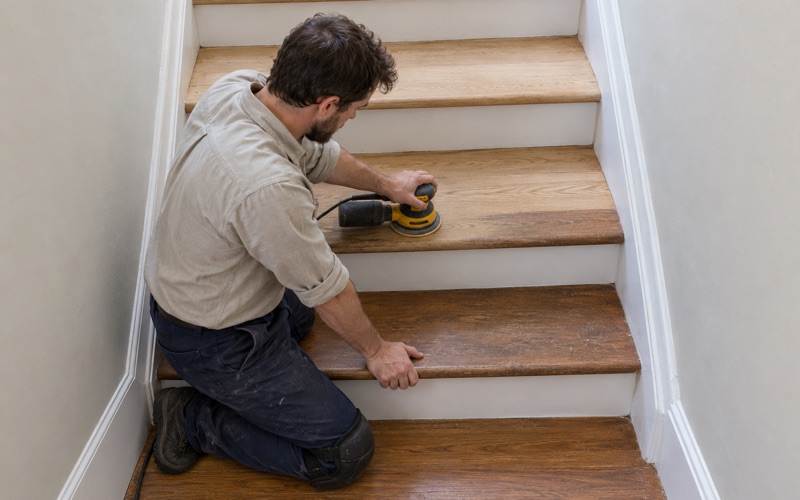
The stair is often the most detailed part of a house like this, and the treads take the hardest wear. We quote stairs tread by tread rather than by square foot, because each tread, riser and nosing is its own piece of work, and protect the balusters and rail while we sand.
Where a tread is split or worn through, we replace that single tread and match it to its neighbors, rather than rebuilding a stair that still has most of its original pieces.
- 20+ Years With Wood Floors
- Written Itemized Estimates
- Free Estimates