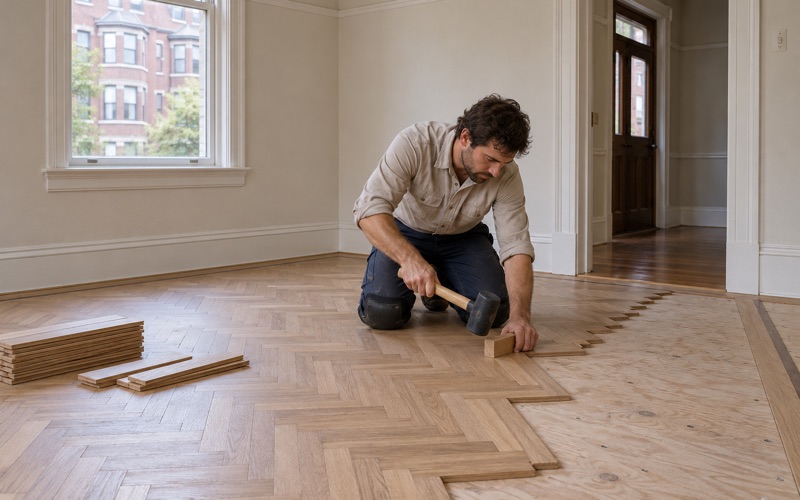
Somerville Wood Flooring has spent more than 20 years on wood-flooring in Waltham, and a growing share of that work starts with a decision that has nothing to do with stain. The owner of an older house has chosen to renovate it rather than replace it. Once that choice is made, the floors already in the house become something to protect, not debris for a dumpster.
A renovation is hard on wood. Plaster comes down, electricians drag reels of cable across the rooms, and a kitchen crew sets cabinets on whatever surface is closest. We plan the floor side of the project from the first walk-through, so the boards worth keeping survive months of other trades and come out looking deliberate rather than patched.
Our part usually comes in three stages: an early assessment of which floors to save, protection while the rest of the work goes on, and a full sand and finish once the dust has stopped. The sections below walk through each stage, starting with the city rule that sometimes pushes a Waltham owner toward renovation in the first place.
How Waltham’s Twelve-Month Demolition Delay Works
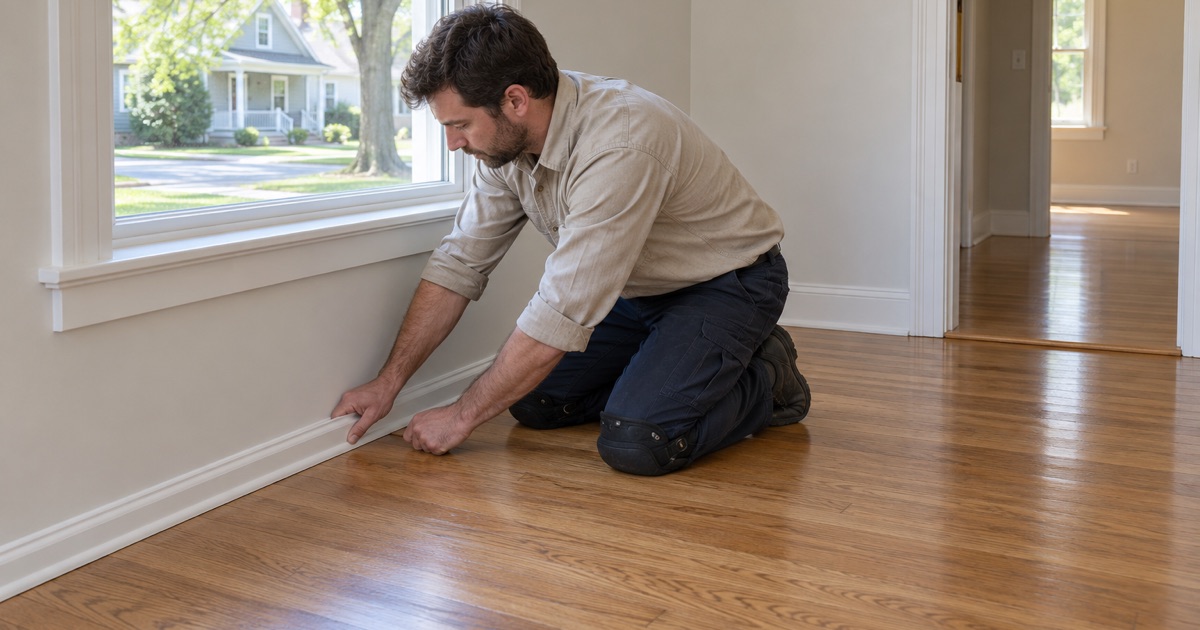
Waltham does not let every older building come down on the owner’s schedule. Under Chapter 23 of the city’s ordinances, titled Delayed Demolition, the Waltham Historical Commission is authorized to advise the Building Inspector on demolition permit applications. Article I of that chapter is titled Preservation of Historically Significant Buildings, which says plainly what the rule is for.
The Delay for a Preferably Preserved Building
When a building is found “preferably preserved” under the chapter, it is subject to a twelve-month demolition delay. That period used to be half as long. City Council Order #31660, adopted December 27, 2011 and approved by Mayor Jeannette A. McCarthy the following day, struck the six-month language and put twelve months in its place.
A year is a long time to carry a house you meant to knock down. For some owners the plan changes during that wait, and renovating the existing building becomes the project rather than the fallback. We cannot tell you whether a particular house would be found preferably preserved, because that finding belongs to the Commission under criteria set in the ordinance itself.
What the Rule Does Not Reach
The delay concerns demolition. Nothing in Chapter 23, as we have read it, speaks to sanding, staining or replacing a floor, and it is not a review of interior finishes. Questions about permits for the wider renovation belong with the City of Waltham building department, and we would rather point you there than guess.
What the rule does is keep certain older houses standing long enough for their owners to look hard at what is inside them. That is often where we come in, sometimes before the architect has finished the drawings.
Why the Question Comes Up So Often Here
The housing stock explains it. Of Waltham’s 26,728 housing units, 7,561 were built in 1939 or earlier, which is 28.3 percent, and 49.2 percent were built before 1960. Only some of those houses will ever be the subject of a demolition application, but a city with that much prewar housing has a great deal of original wood hiding under carpet, linoleum and decades of finish.
Waltham was incorporated as a town in 1738 and as a city in 1884, and some neighborhoods show their age. Piety Corner, listed on the National Register in 1990, holds the city’s largest concentration of well-preserved 19th- and early 20th-century houses. National Register listing is a separate matter from the demolition delay, but houses of that era are exactly the kind whose floors deserve a careful look before anyone decides to replace them.
Looking for wood-flooring closer to Woburn? See Wood-Flooring in Woburn.
Which Old Floors in a Waltham House Are Worth Saving
Not every old floor should stay. Our assessment answers a narrow question for each room: is there enough sound wood left to sand flat and finish, and will the result suit the renovated house? The answer goes into a written, itemized estimate, room by room, so the owner and the general contractor can plan the rest of the job around it.
Checking the Wood Above the Tongue
Old pine and narrow red oak strip floors have usually been sanded before, sometimes more than once. We pull a floor register or look at a threshold edge to see how much wood remains above the tongue before we promise a full sand. Where that layer is thin, a screen and recoat may be the honest answer, and where it is nearly gone, the room may need new boards.
Face nails and cut nails showing through the surface are another clue. They tell us the floor was face-nailed from the start or has been sanded down close to its fasteners, and either one limits how aggressive the grit sequence can be.
Damage That Changes the Answer
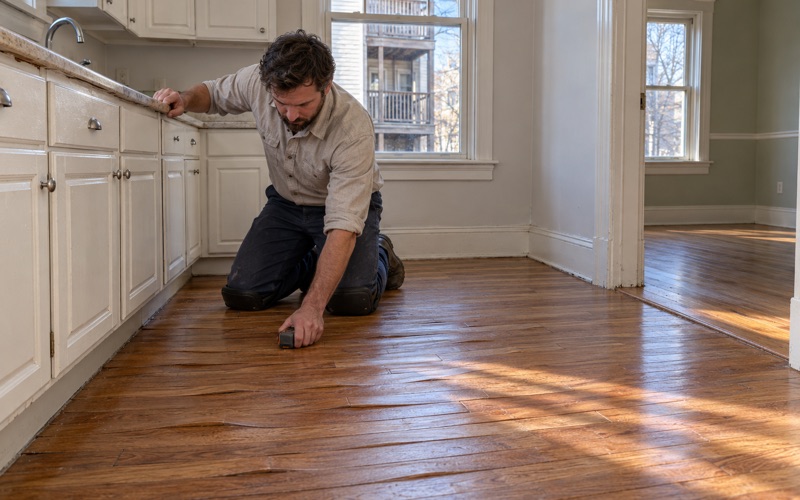
Cupping, crowning and buckling point to a moisture history, so we read the boards with a moisture meter before judging them. Pet urine stains and deep water stains often run through the wood, and those boards are usually replaced rather than sanded. Small round exit holes and powdery frass can signal powderpost beetle or old house borer activity, which calls for a pest professional before any floor work is scheduled.
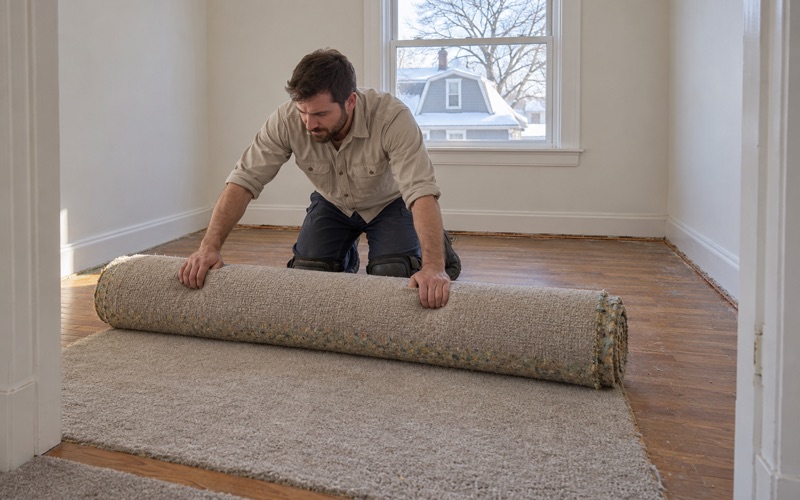
Old resilient floor tile with black mastic beneath it turns up in kitchens and back rooms of older houses. We identify it before anything is sanded and leave it for the right trade. Sanding that layer is not our job, and it should never be left to a guess.
Holes, Patches and Removed Walls
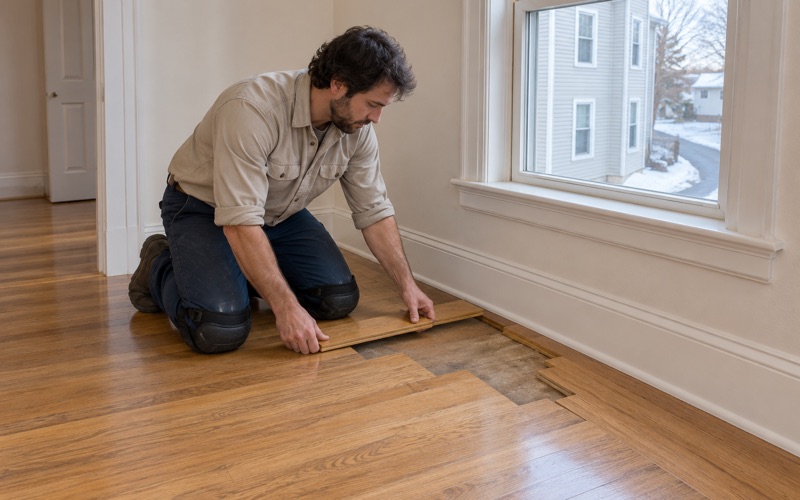
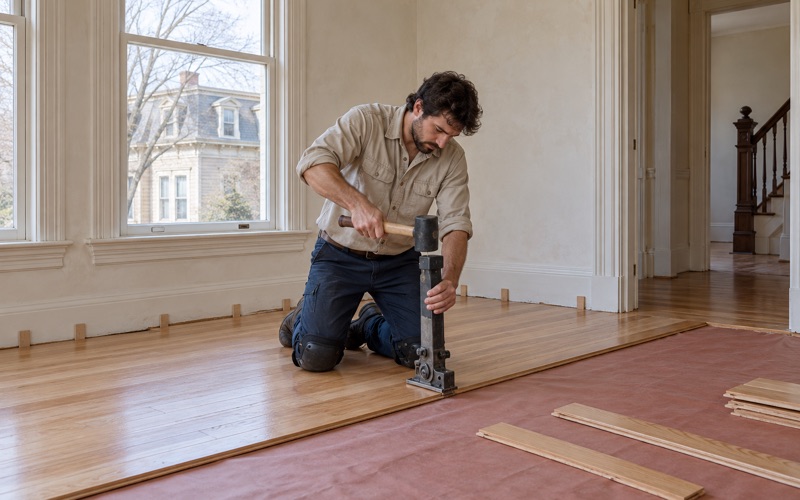
Renovations move walls and heating. Where a radiator, its pipes or a partition came out, we patch the gap with boards woven into the existing floor, so the repair runs with the grain instead of sitting there as a square plug. Matching the species matters: a weave-in repair in eastern white pine needs pine, and red oak strip needs red oak of a similar width.
Protecting Floors While a Waltham Renovation Goes On
A floor worth saving still has to survive the renovation. Plumbers, electricians, drywall crews and cabinet installers all cross it, often for months. We agree on a protection plan with the general contractor at the start, so the floor is covered before the first wall opens rather than after the first gouge.
Covering the Floor for the Long Haul
Thin paper alone does not hold up through a whole-house renovation. We prefer a breathable layer under rigid sheet protection with taped seams, run tight to the walls so plaster dust cannot work underneath. Tape goes on the protection, never on the old finish, because adhesive pulled off shellac or wax can lift the surface with it.
We also ask the other trades to treat the cover as part of the floor. Ladders on pads, cutting stations kept outside and no wet saws in covered rooms save more boards than any sheet material does.
Kitchens, Wiring and Heating Work
Kitchens are where most damage happens. Cabinets and appliances get dragged, and water from a plumbing test can sit under protection for days before anyone notices. We mark the new kitchen layout before demolition so we know which boards will end up under cabinets and which will stay visible, and we check the subfloor and joists while the old flooring there is open.
Electricians fishing wire through old walls and ceilings often need to lift a board or two. We would rather lift those boards ourselves, number them and set them aside, so they go back in the same spot instead of being replaced with wood that does not match.
Lead and Dust Before the First Pass
Massachusetts runs its own lead-safe renovation rules for homes built before 1978. A 1995 city plan estimated that about 19,000 Waltham housing units were built before 1978, so in a house of that age we check the build year and any painted baseboards, thresholds and stair parts before sanding. Our dust containment keeps the work inside the rooms being sanded, with doors and returns sealed.
Why the Floors Get Refinished Last in a Waltham Renovation
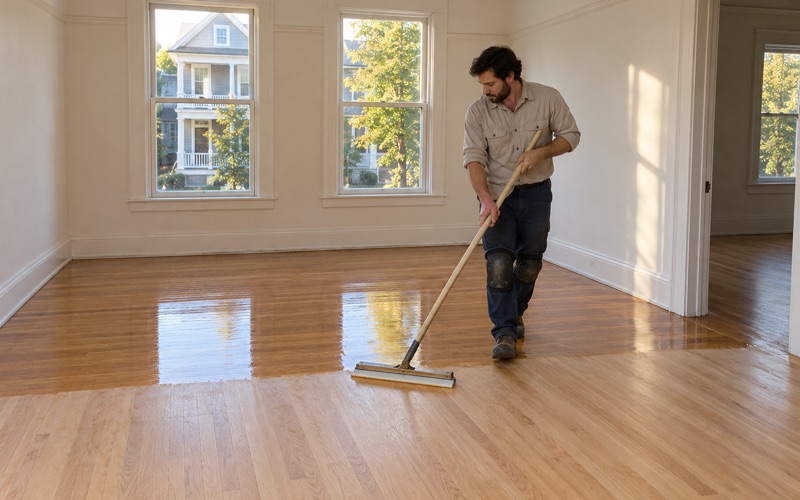
In nearly every renovation we join, the floor finish goes on after every other dusty or wet trade is done. Drywall sanding, painting, trim work and tile grout all put debris on the floor, and fresh polyurethane picks up every particle in the air. Finishing last means the first person to walk across the new finish is the owner, not a painter carrying a ladder.
Sanding the Saved Floors
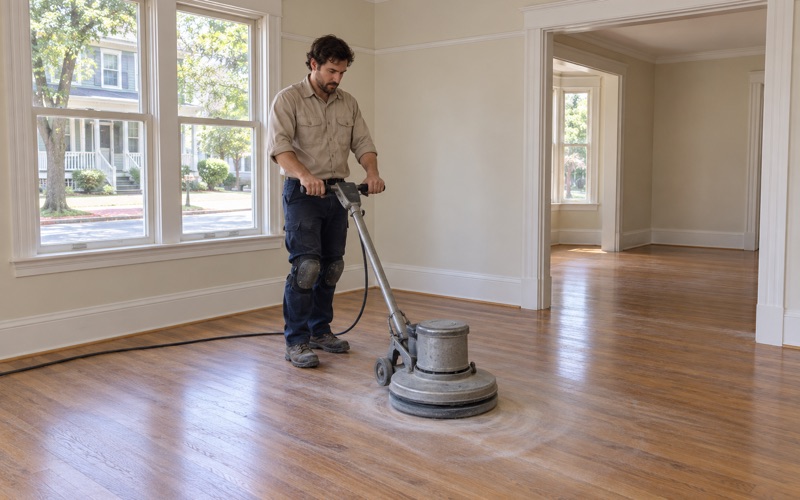
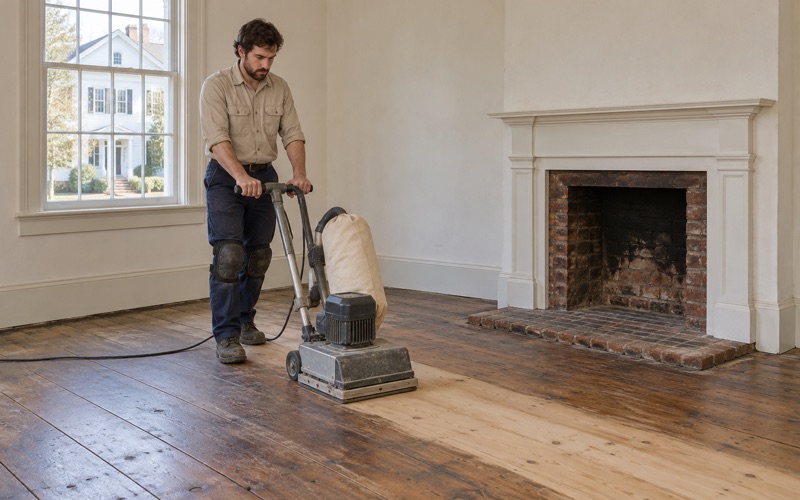
Once the protection comes up, we assess the floor again. Months of renovation traffic can leave new nail pops, squeaky floorboards or board gapping where the heat was off for a season. We reset loose boards, fill where it makes sense, and sand with a drum sander and an orbital sander through a planned grit sequence, with a HEPA vacuum between passes.
Older houses also carry traffic lanes and rug shadow from decades of furniture in the same spots. A full sand removes most of that, but old pine may keep some color variation, and we tell owners so before the stain goes down rather than after.
Choosing Color and Finish in the Finished House
Stain reads differently once the walls are painted and the trim is in, which is one more reason to finish last. We lay stain and sheen samples on the actual floor in the renovated rooms, so the choice is made in the light the owner will live with. Red oak can lean toward orange oak or pink red oak depending on the stain, and a sample on the real boards shows which.
We choose waterborne polyurethane, oil-modified polyurethane or hardwax oil to fit the Massachusetts VOC limits for wood coatings, and we plan drying and fume times around the move-in date. In a renovation, that schedule is usually the last line on the general contractor’s calendar.
Stairs and Transitions
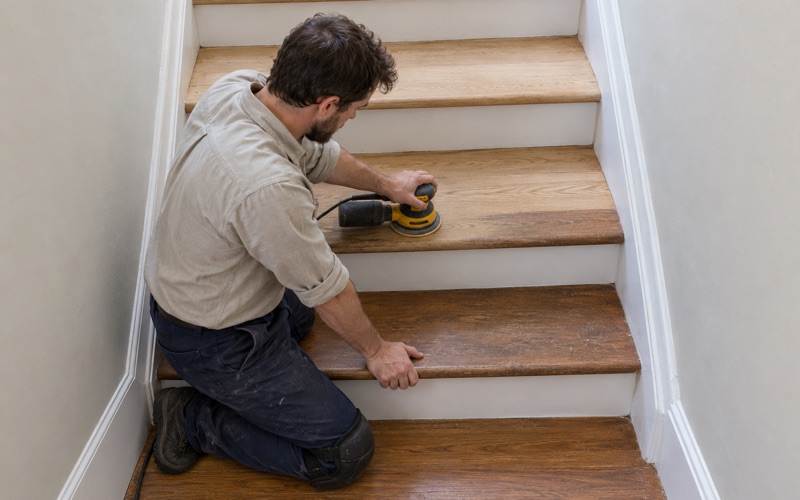
A renovated house often gets new balusters or a rebuilt stair, and we quote the staircase tread by tread, because a staircase is not priced by the square foot. Stair treads, risers and stair nosing are sanded and finished to match the floors they meet. Transitions to a new tiled bathroom or kitchen are set before the final coat, so the saved floor and the new rooms read as one finished house.
- 20+ Years With Wood Floors
- Written Itemized Estimates
- Free Estimates