Somerville Wood Flooring has spent more than 20 years on wood-flooring in Watertown and nearby, and a large share of that work happens in empty rooms. A landlord calls when one tenant has handed back the keys and the next one has already signed. Our job is to sand, repair and finish the floors in the days between, then hand the unit back clean and dry before the new lease begins.
That timing shapes every quote we write for a rental. We ask for the move-out date, the move-in date and whether anyone else in the building shares a hallway or a stair. With those three facts we can tell you whether the gap fits a full sand and refinish, a screen and recoat, or a repair limited to the worst rooms.
Owners who live in one half of a house and rent the other half get the same planning. We keep the dust inside the vacant unit, schedule any shared stair around the people who use it, and leave an itemized estimate you can file with the rest of your turnover records.
Floors in Watertown Rentals Under the 31-Day Rule
Watertown’s zoning prohibits renting a property for less than 31 days, and the city’s Zoning and Code Enforcement Office has written to properties identified as operating short-term rentals. Those letters asked owners to confirm by email that a listing met the 31-day minimum, or to send a signed letter stating when the rental stopped. For a landlord, the practical result is simple: a Watertown unit changes hands by the lease, not by the night.
A Proposal That Did Not Pass
In March 2024 the Planning Board recommended a limited ordinance for owner-occupied short-term rentals. The owner would have had to live in the property nine months out of 12, appear on a public registry with notice to abutters within 300 feet, and rent short-term no more than three months a year. In April 2024 the City Council rejected the proposal.
So the 31-day minimum still stands, and the 2024 debate left it in place. For the floors, that matters more than it might seem. A unit that changes hands only when a lease ends wears in long stretches, with traffic lanes and rug shadow building up for months before anyone sees the bare room again.
A City Where Most Households Rent
Census figures show 8,557 of Watertown’s 16,371 occupied units are renter-occupied, which works out to 52.3 percent. More households here rent than own. That puts a lot of floor work on a landlord’s calendar rather than a homeowner’s, and the calendar is set by lease dates rather than by convenience.
The building type matters too. Two-unit structures are Watertown’s largest category at 5,969 units, 34.7 percent of the housing stock, and 2,952 renter households, 34.5 percent of all renters in the city, live in a two-unit building. Many of our Watertown jobs are one floor of a two-family house, emptied for a short window between tenants.
Older Floors Under Each Lease
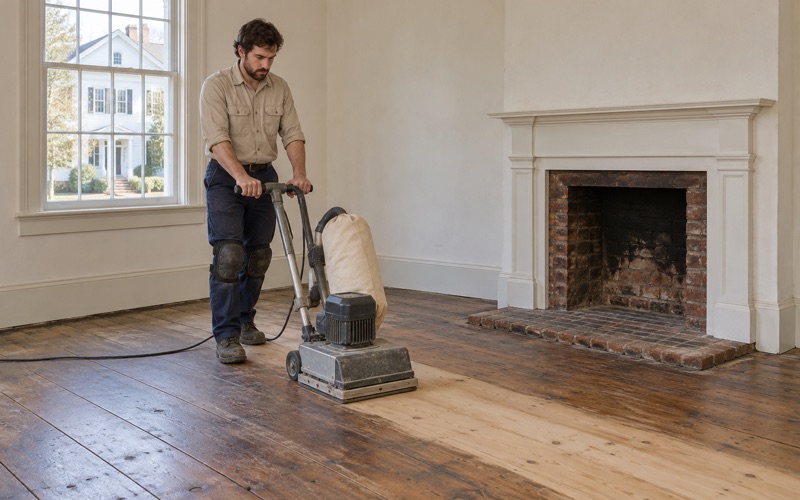
About 44.4 percent of Watertown’s housing units were built in 1939 or earlier. In those buildings we often find narrow red oak strip flooring, eastern white pine, or a mix where a kitchen was redone decades ago. Every past sanding has taken some wood off, so we check how much remains above the tongue before a drum sander touches the floor.
Looking for wood-flooring closer to Roxbury? See Wood-Flooring Services in Roxbury.
Refinishing a Watertown Rental Between Tenants
A vacant unit is the best chance a landlord gets to fix a floor properly. With the furniture gone and nobody living there, we can sand wall to wall, reach into the closets, and let the finish cure without anyone walking on it. What we do in that window depends on how worn the floor is and how many days the gap gives us.
Full Sand and Refinish
When the finish is gone in the traffic lanes, the boards have turned gray, or pet urine stains have soaked in, the floor needs a full sand. We work through a grit sequence with a drum sander on the field and an orbital sander at the edges, then apply stain if you want it and the topcoats. We choose finishes that fit the Massachusetts VOC limits for wood coatings.
Before any color goes down, we lay stain and sheen samples on the floor itself. Red oak can turn orange oak or pink red oak under the wrong stain, and a sample on your own boards is the only reliable way to see that before it covers a whole apartment. Approving a color takes minutes once the samples are dry.
Screen and Recoat
If the existing finish is sound and only dull or lightly scratched, a screen and recoat may be all a unit needs. We abrade the top layer and add a fresh coat without cutting into the wood. It is quicker and leaves the remaining wood alone, but it will not fix deep scratches, water stains or peeling polyurethane, and a new coat will not bond over wax residue.
Repairs a Tenant Leaves Behind
Turnover is when the damage shows: a scratch pattern by the door, a water ring under a plant stand, squeaky floorboards and nail pops that a rug hid for years. We replace damaged boards with matching stock and weave them into the field. Holes left where a radiator or its pipes came out get the same weave-in repair, so the patch reads as part of the floor.
If the trouble came from the unit above, we trace the leak, dry the floor and take moisture meter readings before anything is sanded. We document the readings room by room so the owner has a record for the adjuster. We also watch for cupping or buckling, which tells us the boards are still holding water and are not ready to sand.
Planning Floor Work Around a Watertown Move-Out Date
Most of the risk in a turnover job is scheduling, not sanding. A floor finished one day late can hold up a tenant who has movers booked, and a finish walked on too soon can mark before the lease is a week old. We plan from both ends of the gap so neither of those happens.
Starting From the Lease Dates
Give us the day the outgoing tenant hands back the keys and the day the next one moves in. We set the sanding, staining and coating days inside that window and leave drying time before the move-in, not after it. If the gap is too short for a full refinish, we say so in the estimate and offer a recoat or a room-by-room plan instead.
Waiting until the unit is empty to call usually costs days. A walk-through while the outgoing tenant still lives there lets us measure, look at the worst rooms and order any replacement boards in advance. Then the first morning after move-out can be a working day rather than a site visit.
The Other Unit Stays Occupied
In a two-family house, the other floor usually has people living in it while we work. We seal doors and returns, keep dust containment inside the vacant unit, and run a HEPA vacuum at the end of each day. Fume and drying times are planned around the household that is still in the building, including when they cook and sleep.
Common hallway stairs need their own schedule. If the stair to the upper unit needs refinishing, we write the closure dates down in advance so every unit that uses it knows when it is out of service. Stairs are quoted tread by tread, because a staircase with worn stair nosing and scuffed risers is not priced by the square foot.
Checks Before the Sander Starts
Massachusetts runs its own lead-safe renovation rules for homes built before 1978, and 77.7 percent of Watertown’s housing units were built before 1980. We check the build year and any painted surfaces, such as baseboards or stair risers, before sanding begins. That check is written into the schedule from the first day, not squeezed in on the morning of the job.
Old resilient floor tile and black mastic sometimes turn up under carpet in a kitchen or back hall. We identify it before anything is sanded and leave it for the right trade, which can change the order of work in a tight turnover. Knowing about it during the walk-through keeps that discovery from eating into the gap.
Getting a Watertown Unit Ready for the Next Lease
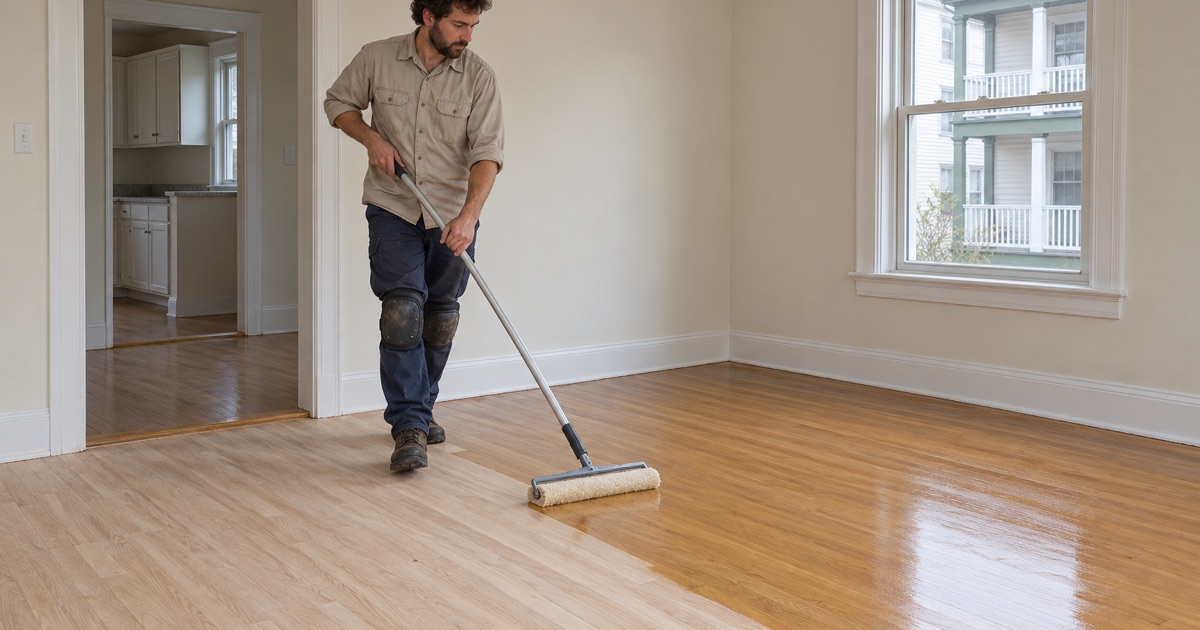
The last days of a turnover are about handing back a unit a new tenant can move into without a smell, a tacky floor or a surprise. We finish with that day in mind, so the last coat has dried hard enough to take boxes and furniture on move-in day.
Choosing a Finish That Lasts a Lease
A rental floor often takes harder use than an owner-occupied room. We usually suggest a satin or matte sheen level, which hides scuffs and dust better than gloss, and enough coats of waterborne polyurethane to carry the floor through the lease. Oil-modified polyurethane and hardwax oil have their place, but their drying and cure times are harder to fit into a short gap.
Rentals of Every Size
Watertown was founded and incorporated in 1630, and its housing has been added in layers ever since, in neighborhoods such as Bemis, Coolidge Square, East Watertown and the West End. Rentals here range from two-family houses to large buildings, with 2,528 units, 14.7 percent of the city’s housing, in buildings of fifty or more units.
In a large building with a condo association, we plan the work around the association’s own notice and work-hour rules, read from the documents rather than assumed. In an older house, one bedroom may still have original pine while the kitchen has newer oak over a plywood subfloor. We read each room separately and tell you which ones can take another full sand.
Paperwork That Stays With the Unit
Every job starts with a written, itemized estimate and ends with a record of what was done in each room. A landlord can keep it with the move-out paperwork Massachusetts asks for, alongside photos of the floor before and after. When the next lease ends, that file gives you a clear starting point for judging the floor’s condition.
If your Watertown unit has a move-out date on the calendar, call us before the keys come back. We will look at the floors, go through the lease dates with you and tell you plainly what fits in the gap, whether that is a full refinish, a recoat or a few repaired boards.
- 20+ Years With Wood Floors
- Written Itemized Estimates
- Free Estimates