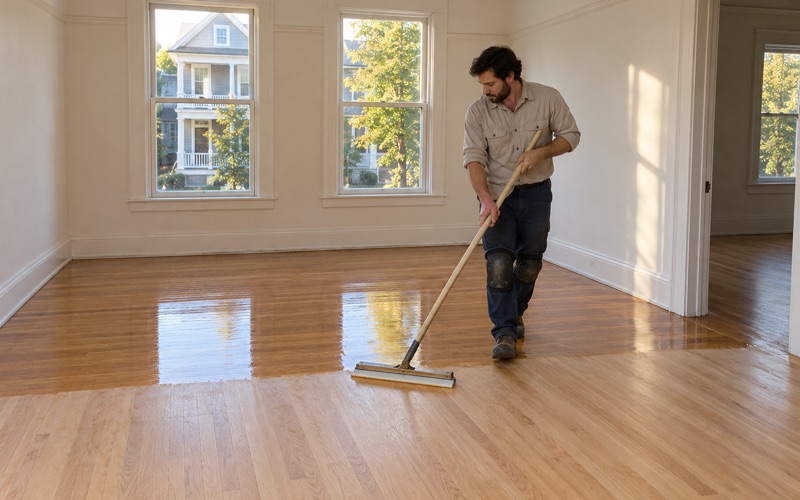
Somerville Wood Flooring brings more than 20 years of hands-on work to wood flooring in West Roxbury, and most of the floors we meet here are worth saving rather than covering. We sand and refinish, weave in new boards, rebuild stair treads and install new solid hardwood. What we decide in each house depends on what the floor is made of and how much wood remains.
That second question matters most on old red oak strip and pine. A floor that has been sanded three or four times may have little left above the tongue, so we pull a register or a threshold and look before we quote. If the wood above the tongue is thin, we say so and plan a lighter cut or a screen and recoat instead of a full sanding.
Every estimate we hand over is written and itemized, room by room and stair by stair, so you can file it and compare it line by line. Stain and sheen samples go down on your own boards before anyone commits to a color, because the same stain reads differently on pine than on oak.
Floors in West Roxbury’s Oldest House Lots
West Roxbury did not fill in all at once. It broke away from Roxbury as its own town in 1851, the same year rail service reached it, and Boston annexed it in 1874. Through those decades, land near the stations was laid out in house lots and sold, and the older houses on those streets are where we expect to find the oldest floors.
In ZIP 02132, which covers West Roxbury, the Census Bureau’s American Community Survey counts 5,310 of 11,982 housing units as built in 1939 or earlier. ZIP-level figures are a labeled proxy rather than a neighborhood boundary, but the share is plain: more than four in ten homes there predate the Second World War. In houses of that age we expect to meet cut nails, face nails along the walls, and finishes that began as shellac or wax.
What the Oldest Floors Are Made Of
Houses of this era around Boston commonly have narrow red oak strip flooring in the main rooms, with maple, eastern white pine or Douglas fir turning up in kitchens, back halls and upper floors. Old red oak often carries an orange cast from decades of oil-based finish. We test a small patch first to learn whether the top coat is polyurethane, shellac or wax, because each sands differently.
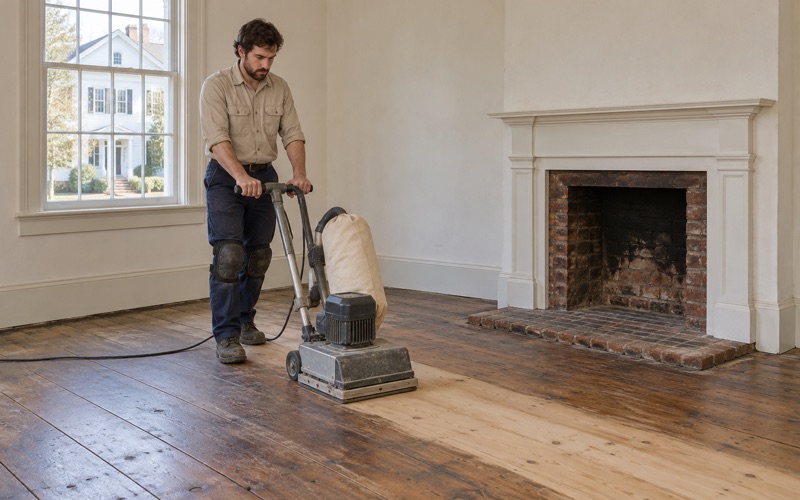
Wax residue loads sandpaper within a few feet and can keep a new finish from bonding, so it comes off before the drum sander gets serious. Shellac softens under heat and gums the paper. Neither problem is unusual in a house this old, and both are cheaper to plan for than to discover halfway through a room.
Lead-Safe Work Before 1978
Every house built in 1939 or earlier was also built long before 1978, the cutoff for the Massachusetts lead-safe renovation rules that run alongside the federal EPA RRP Rule. We confirm the build year and check painted baseboards, shoe molding, stair stringers and old floor paint before we sand. Where paint will be disturbed, the work plan changes, and we tell you how before the job starts.
Old resilient floor tile and black mastic are a separate matter. If a kitchen or back hall has tile glued over the wood, we identify it before any sanding and leave its removal to the trade that handles it, then refinish the wood once it is clear. Sanding through mastic spreads it into the grain and the air, which is the reason we stop.
Looking for wood-flooring closer to Nahant? See Wood-Flooring Services in Nahant.
The 1855 Auction Plan and the Spring Street Station Lots
The Norman B. Leventhal Map & Education Center at the Boston Public Library holds a sheet titled ‘Plan of dwelling houses & house lots, in West Roxbury,’ dated 1855. It was drawn for a sale at auction, and the catalog record carries the line ‘To be sold at auction by N.A. Thompson, Auctr.’ That is four years after West Roxbury became a town.
The title names dwelling houses as well as house lots, and the sheet is drawn at a scale of 1:1,200. The catalog record gives no lot count and no street list, so we cannot tie the sheet to present-day addresses. What it does show is West Roxbury land being divided and offered to buyers well before the Civil War.
Building Lots Near Spring Street Station
A second sheet in the same collection is the West Roxbury Land Company’s Plan No. 1 of building lots near Spring Street Station. It was surveyed by T.B. Moses and published by W.H. Forbes & Co., and the library dates it to about 1870, an inferred date rather than one printed on the plan. Its title says plainly what it was for: selling lots close to a railroad stop.
Houses built on station lots like these were the commuter homes of their day, and the floors in them have had a long working life. We often find traffic lanes worn through the finish from the front door to the kitchen, rug shadow around old furniture lines, and pet urine stains or water stains near radiators and back doors. A full sanding takes out most traffic lanes, while deep black stains usually mean board replacement.
Old Floors, Old Fastenings
Floors of this age were often face nailed with cut nails near the walls, and those nails work loose over a century of seasons. Nail pops and squeaky floorboards are common, and a cut nail head standing proud will tear a sanding belt. We set or replace loose fasteners before the first pass and add flooring cleats or screws into the joist where a board has lifted.
Insects are worth a look in wood this old. Small round exit holes with fine powdery frass can point to powderpost beetle or old house borer, and soft, hollowed wood near a damp sill can mean carpenter ants. We point out what we see before we sand over it, since live insects call for a pest specialist before refinishing makes sense.
The Mount Vernon Land Company and Its House Lots
A third sheet, dated by the library to about 1892, is a plan of house lots on Mount Vernon Street owned by the Mount Vernon Land Company. The title gives the company’s address as 257 Washington Street, Room 3, and the back of the sheet carries a descriptive circular. In other words, the plan doubled as a sales piece.
By then West Roxbury had been part of Boston for nearly two decades, and land companies were still dividing it into lots for new houses. As with the earlier plans, the record names no lot count and no list of streets beyond Mount Vernon Street itself, so we treat it as a rough marker in time rather than a map of today’s addresses.
Floors in the Houses That Followed
Houses from the end of the nineteenth century can hold narrow red oak strip in the front rooms, a border or parquet inlay at the parlor, and pine or fir in service spaces. Borders and parquet change grain direction every few inches, so we cut them with an orbital sander and hand tools rather than letting a drum sander cross them.
Old eastern white pine is soft; it dents and sands away much faster than oak. On pine we use a gentler grit sequence and stop as soon as the old finish and the worst wear are gone, keeping the character a century of use has given the boards. We tell you up front that a pine floor will keep some dents, because sanding them all out would cost too much wood.
Radiator Holes and Missing Boards
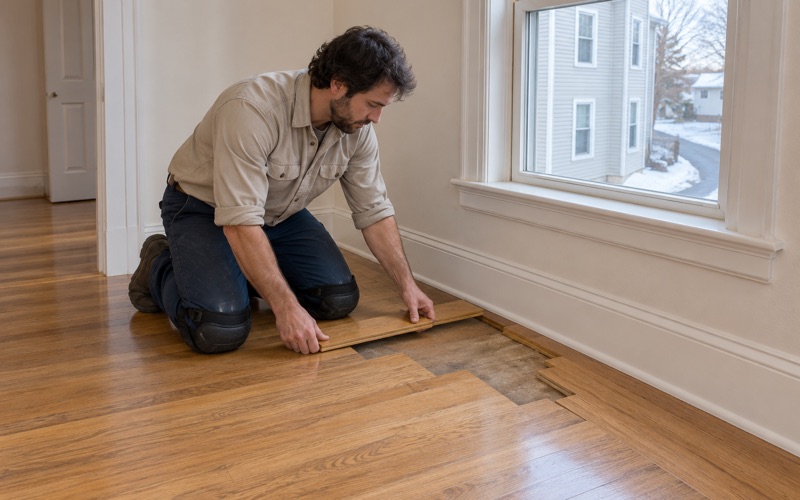
Houses of this age have often lost a radiator, a pipe chase or a wall over the years, leaving a hole or a patch of mismatched boards. We fill these with a weave-in repair, toothing new boards into the old rows so the joints stagger the way the original floor does. A radiator hole patch done that way blends in under the finish instead of reading as a square.
Matching matters as much as the weave. Old red oak has aged toward amber, while new red oak can look pink until it is finished, so we pick replacement stock by species and width and then test stain on both before committing. Salvaged boards from a closet or under a built-in are sometimes the closest match the house can give.
Planning a Floor Project in an Older West Roxbury House
West Roxbury is mostly single-family homes with some two-family houses, and the Planning Department counts 68.2 percent of its occupied units as owner-occupied. ZIP 02132 also holds 1,614 units in two-unit buildings, a labeled proxy. That mix shapes the schedule: an owner living in the house, or a family upstairs, needs rooms kept usable while we work.
Working Around the People Who Live There
In a two-family house we refinish one unit or one floor at a time, so the household on the other level stays home. Doors and returns are sealed and a HEPA vacuum runs with the sanding, keeping dust inside the space being worked. If the house shares a front hall, the stairs and landings get their own dates, written down in advance for everyone who uses them.
Finish choice follows the same thinking. A waterborne polyurethane dries and airs out faster than an oil-modified polyurethane, while a hardwax oil gives a low sheen level and allows spot repairs later. We choose products that fit the Massachusetts VOC limits for wood coatings and set drying times around who will be in the house.
Seasons, Rentals and Stairs
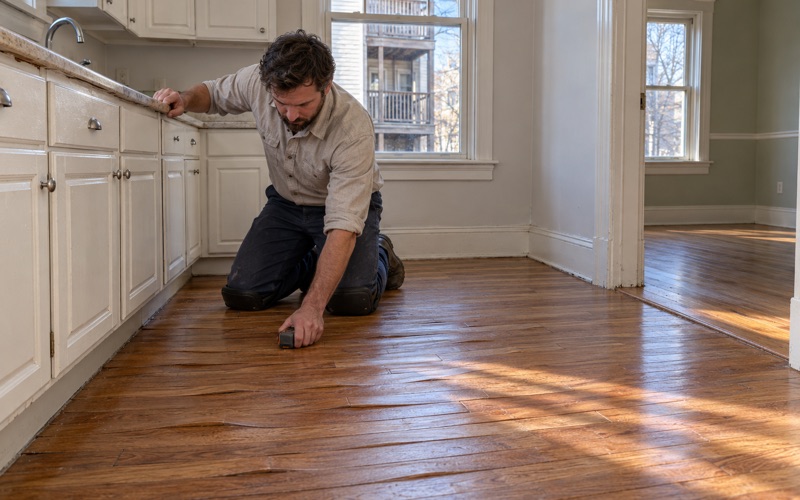
West Roxbury sits in National Weather Service forecast zone MAZ015, Suffolk, and like the rest of the zone it swings from dry, heated winters to humid summers. Old strip floors show it as winter gaps between boards and, after a wet spell, cupping. We read the boards with a moisture meter before sanding, because a floor sanded while cupped can crown once it dries.
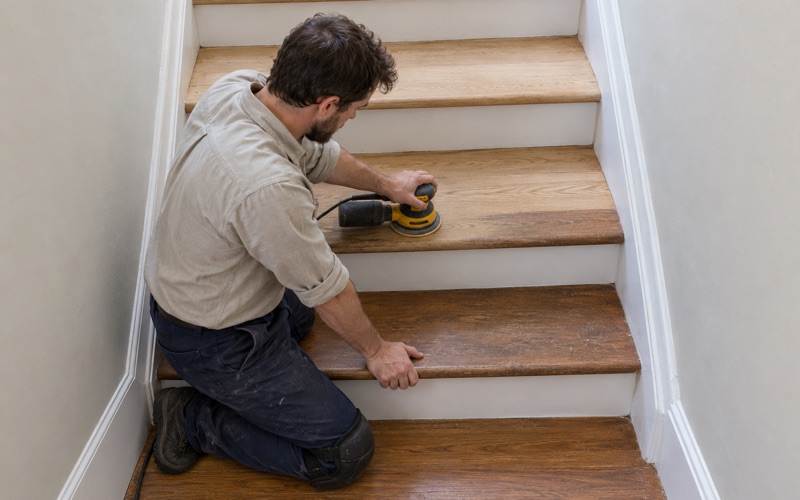
Boston runs annual rental registration and a five-year rental inspection, though owner-occupied buildings of six or fewer units are exempt from the inspection. For landlords, we sand and finish a vacant unit between leases and hand over an itemized estimate to keep with the move-out paperwork. Staircases are priced tread by tread, with treads, risers and nosing counted separately rather than by the square foot.
- 20+ Years With Wood Floors
- Written Itemized Estimates
- Free Estimates