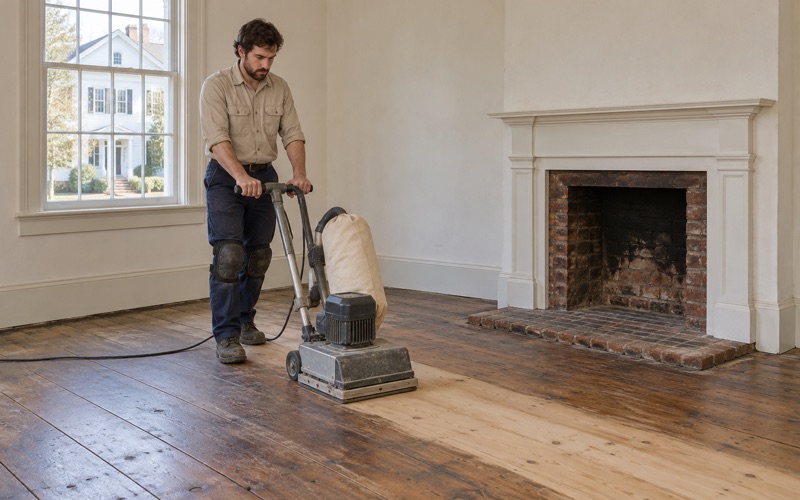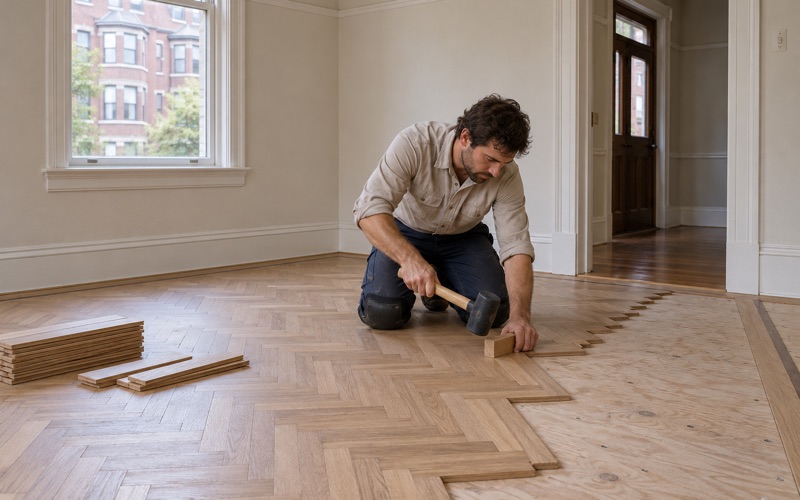
Somerville Wood Flooring brings more than 20 years of sanding, repair and refinishing to wood flooring in Woburn, and much of what we see here comes from one generation of houses. The floors we are called to are often 60 to 75 years old. Some have never been sanded, some have had a refinish or two, and some have spent decades under wall-to-wall carpet.
That age changes how a job is planned. A floor this old has a limited amount of wood left above the tongue, and every past sanding has spent some of it, so we measure before we quote rather than assuming another full sand is possible. We would rather tell you a floor has one sanding left than sell a job it cannot take.
Every price comes as a written, itemized estimate, room by room and stair by stair, so you can see where the money goes before anything is moved. In a two-family house we can work one floor at a time while the other household stays home, with doors and returns sealed so the dust stays in the unit we are sanding.
Woburn Grew Fastest Between 1950 and 1965
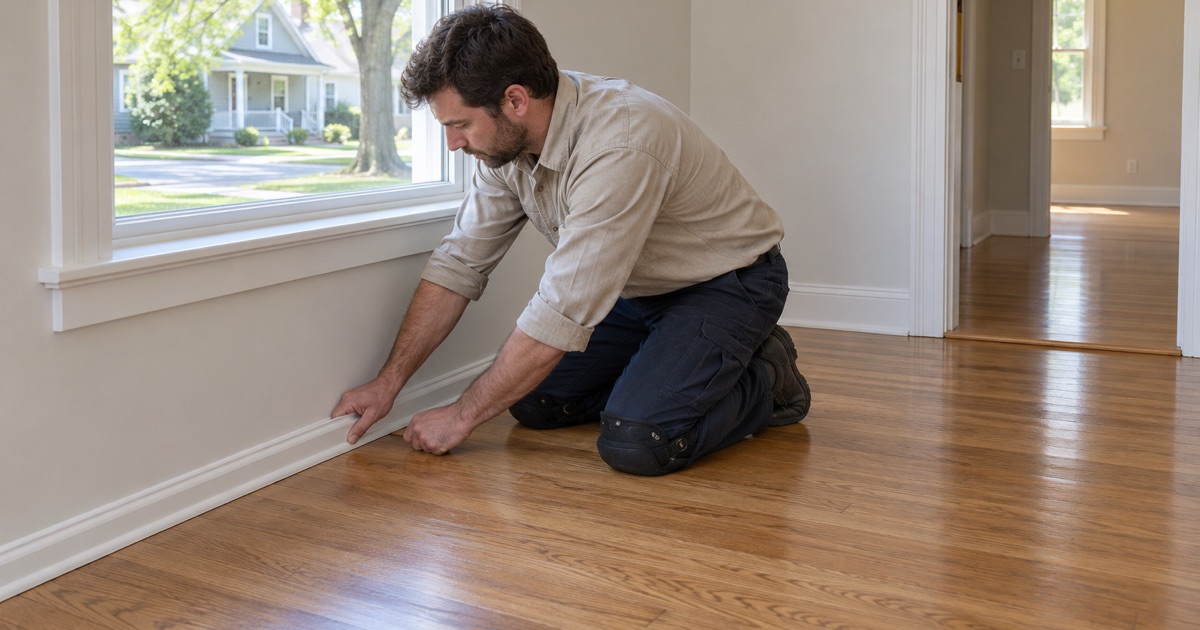
Woburn’s housing history has a gap in it that explains a lot about its floors. The Massachusetts Historical Commission’s 1980 reconnaissance survey of the city found that the only real growth between 1915 and 1940 came in the 1920s, and that population growth was negligible through the Depression and both World Wars. Only a few bungalows are known to have been built in that stretch.
Then the curve turned. Since 1945, the survey reports, Woburn’s population nearly doubled, and most of that rise came in the 15 years from 1950 to 1965, when the city grew by almost 1,100 people a year. Growth at that pace leaves a city with a large group of houses of roughly the same age, and many of them are now due for floor work.
The 1950s Outbuilt Everything Before 1940
Census figures back the survey up. The American Community Survey counts 3,206 Woburn housing units built in the 1950s, slightly more than the 3,181 built in 1939 or earlier, and another 1,878 built in the 1960s. Measured by what still stands, a single postwar decade outnumbers every surviving home from before 1940.
Put another way, 41.3 percent of the city’s units were built before 1960, and the 1950s alone account for 18.8 percent of all units. So when a Woburn homeowner calls about a tired floor, we ask the build year first, because it tells us a great deal about what to look for before any sander arrives.
Where the Postwar Houses Went
The survey traces where that growth landed. Suburban expansion ran along Main Street toward Winchester, around Horn Pond, and in North Woburn, with secondary development along the Washington Street axis toward Montvale and along the Cambridge Street corridor near its Lexington Street junction. Those are the neighborhoods where we most expect to find original floors from the 1950s and 1960s.
Woburn had already reached 16,410 people by 1915, when it was still virtually a one-industry leather city. The postwar houses were added to that older town rather than replacing it, which is why we never assume a floor’s age from the street alone and always confirm it inside.
Looking for wood-flooring closer to Lexington? See Wood-Flooring Services in Lexington.
What Lies Under the Carpet in a Postwar Woburn Home
We do not assume what flooring a house from this era has, because each one has its own history of owners and renovations. What we can say is that wall-to-wall carpet became common in many American homes during the decades after these houses were built, and an original wood floor sometimes survives underneath it. The only way to know is to look.
Pulling a Corner First
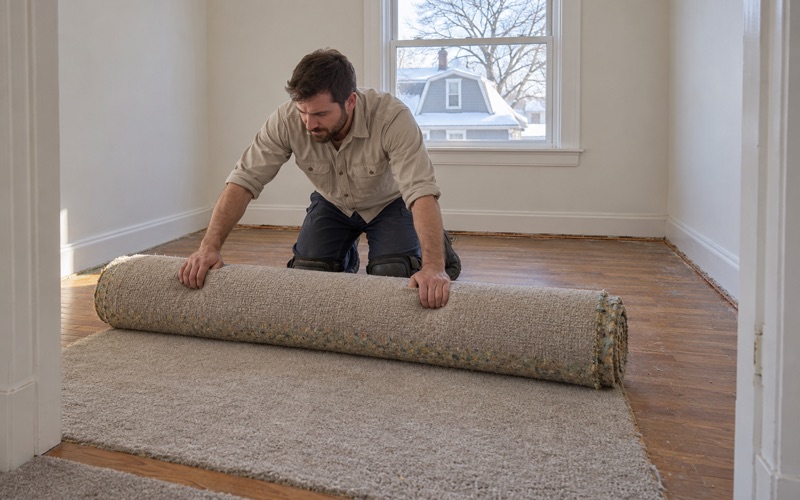
Before quoting a refinish under carpet, we lift a corner in a closet or along a wall, usually where the tack strip meets the baseboard. That small opening shows whether there is solid hardwood, an engineered floor, plywood or old resilient floor tile beneath the carpet pad, and it leaves no visible damage once the carpet goes back.
If wood turns up, we identify it on the spot, whether red oak strip flooring, white oak, maple or another species, and note whether the boards are held by face nails or blind-nailed through the tongue and groove. That tells us how the floor will sand and which repairs are realistic.
What Carpet Leaves Behind
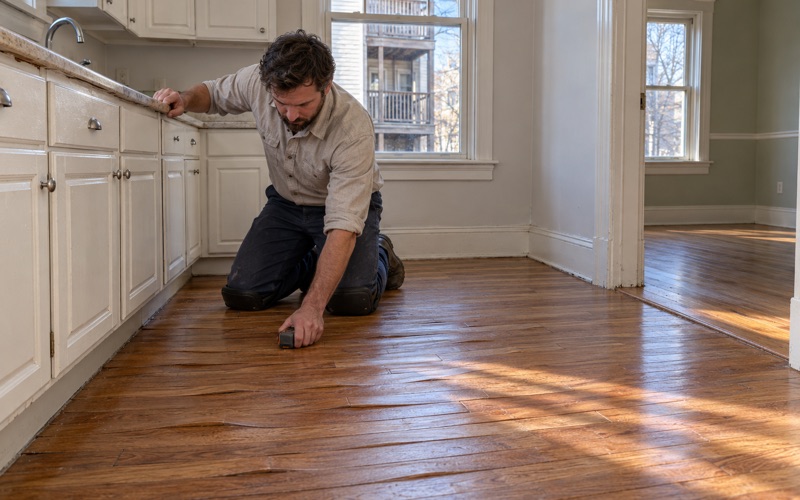
Decades under carpet protect a floor from foot traffic, but they leave their own marks. We commonly find rows of staple and tack strip nail holes around the edges, pad residue stuck to the finish, and pet urine stains or water stains that soaked through the pad and darkened the wood.
A rug shadow, where a carpet runner or area rug once kept light off the boards, often sands out with the old finish. Deep pet stains are different, because they can run through the wood, and we usually recommend a weave-in repair with new boards rather than chasing a stain that will not lift.
Tile and Mastic Under the Carpet
In some houses, resilient tile was laid over the wood before any carpet went down. If we find old tile or black mastic, we stop and identify it before any sanding, because those materials can contain asbestos and are not something to grind through. That work goes to the right trade, and we return once the surface is clear.
Refinishing an Original Floor After 60 Years
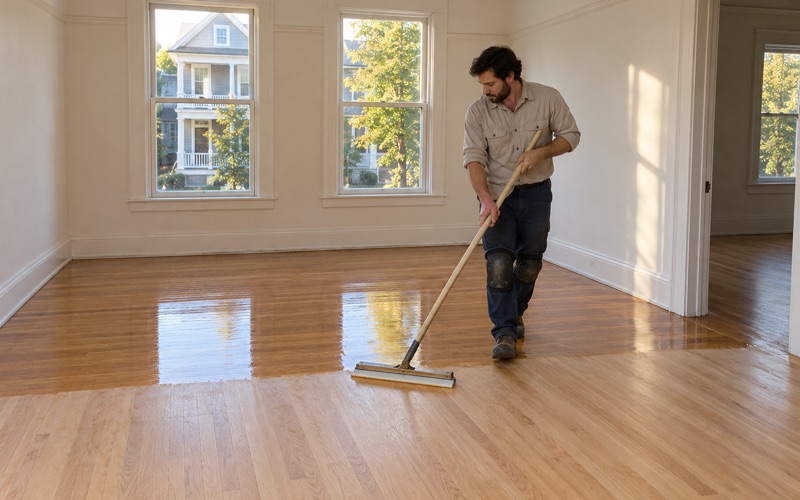
A floor installed in the 1950s or 1960s has had a long working life, and the questions we ask are practical ones: how much wood remains above the tongue, how many times it has already been sanded, and whether the old finish is polyurethane, shellac or wax. The answers decide whether the floor gets a full sand, a lighter screen and recoat, or repairs first.
First Sand or Third
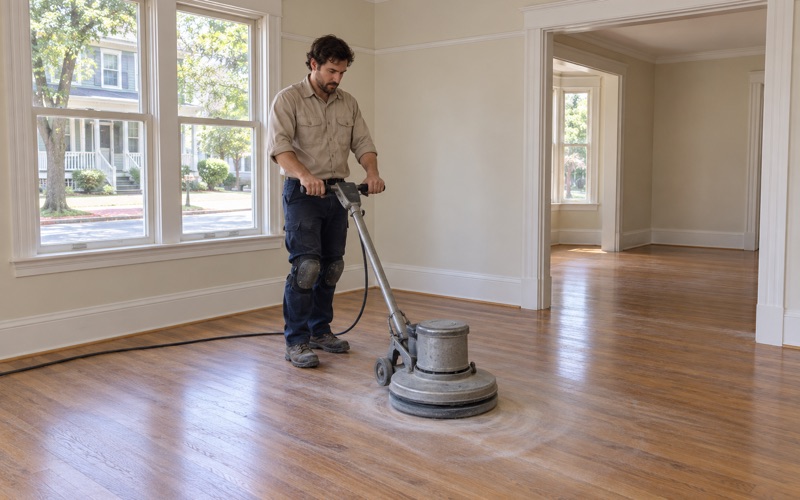
We pull a floor register or a threshold to read the board edge and see how much wood is left above the tongue. A floor that has never been sanded usually has room for a full grit sequence with a drum sander. One that has been through two earlier refinishes may only have enough wood left for a careful, shallow pass, and we say so in the estimate.
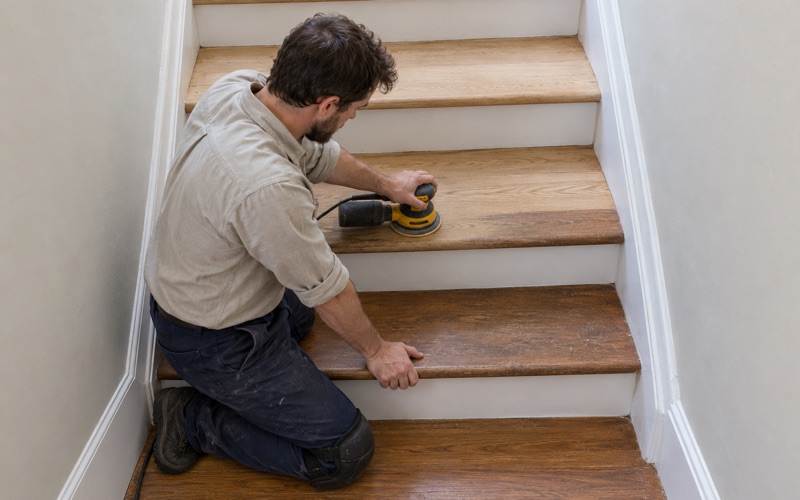
Exposed nail heads, nail pops and squeaky floorboards get fixed before sanding, since a proud nail will tear sandpaper and gouge the wood. Loose boards are refastened from above or, where the joist can be reached, firmed up from below. Gaps that open every winter are normal for strip floors in a heated house and usually close again in the humid months, so we rarely fill them.
Old Finishes and Old Colors
Older finishes often amber with age, and an oak floor that looked pale when it was new may now read as orange oak. Sanding to bare wood resets that color, and we lay stain and sheen samples on your own boards so you can judge them in your own light. Pink red oak, for instance, looks different under a clear finish than under a warm stain.
For the topcoat, we choose waterborne polyurethane or oil-modified polyurethane that fits the Massachusetts VOC limits for wood coatings, and we plan drying and fume times around whoever is living in the house. Hardwax oil is an option for owners who want a lower sheen level and easy spot repair.
Lead Rules for a Pre-1978 House
Every house built in the 1950s and 1960s falls before 1978, the line Massachusetts uses for its own lead-safe renovation rules. Floors themselves are rarely painted, but baseboards, shoe molding, stair risers and door casings often are, and sanding near them is where care matters. We check painted surfaces before the sander starts and plan containment and HEPA vacuum cleanup around what we find.
Save or Replace: Deciding on a Postwar Floor in Woburn
Not every original floor is worth keeping, and not every worn one needs to go. The decision usually comes down to three things: how much sandable wood is left, how much damage is concentrated in a few spots, and whether the subfloor beneath is sound. We give you that reading in writing, with the cost of each path side by side.
When Saving It Makes Sense
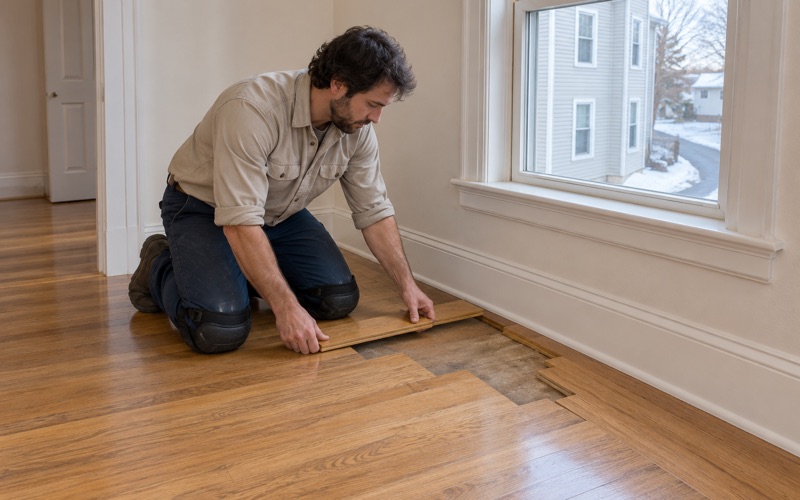
A floor with enough wood above the tongue and damage confined to a few boards is usually worth saving. Holes left where a radiator, its pipes or an old wall came out can be patched with boards woven into the existing field, so the repair follows the grain instead of sitting in it like a square patch.
An original floor from this period also suits the trim, doors and proportions of the rooms it was built for. Keeping one, sanded and finished well, often costs less than tearing it out and installing new solid hardwood or a prefinished floor.
When Replacement Is the Honest Answer
Some floors have simply run out. If earlier sanding has worn down to the tongue, if boards show cupping or buckling from a past leak, or if the subfloor is soft, a fresh sand will not fix the problem. We use a moisture meter to confirm that any old water damage is dry before recommending what goes down next.
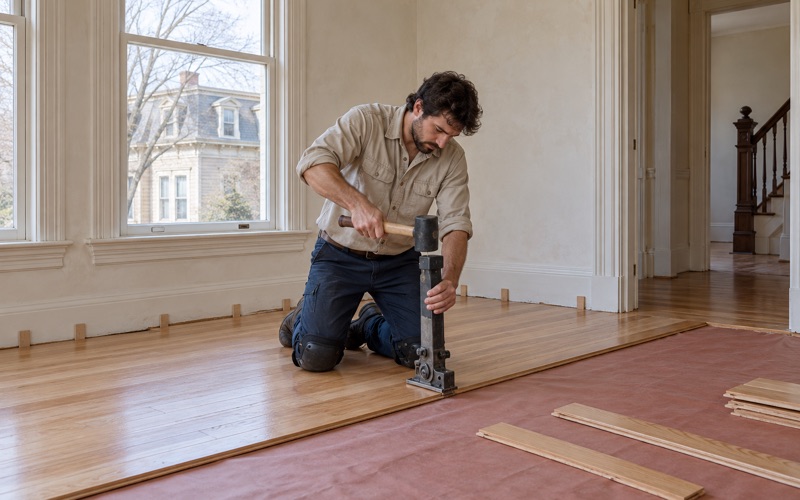
Replacement does not have to mean the whole house. We often replace boards in one room or one damaged area, weave the new boards into the surrounding original floor, then sand and finish the whole level so old and new read as one surface.
Stairs, Single Families and Rentals
Many Woburn owners live in their own detached houses, and the census counts 6,928 owner households in that kind of home. For a single-family job we can often sand a level at a time so the house stays usable. Where stairs are involved, we price them tread by tread, since stair treads, risers and nosing are measured as pieces rather than by the square foot.
Rental units get their own timing. For a vacant unit between tenants, we aim to sand and finish before the next move-in date, and the itemized estimate is one a landlord can file with the move-out paperwork Massachusetts asks for.
- 20+ Years With Wood Floors
- Written Itemized Estimates
- Free Estimates