
Somerville Wood Flooring has done wood floor refinishing in Somerville, MA for 20+ years, serving surrounding cities including Cambridge, Charlestown, Medford, Everett, Back Bay. Most of the floors we refinish are red oak strip and old pine laid when the house was built, and most of them sit in two-families, triple-deckers and condos where other people keep living while we work.
Refinishing means sanding the floor down to clean, bare wood, repairing what the sanding exposes, and building a new finish from the wood up. It is a different job from a screen and recoat, which only freshens an intact finish, and from repair, which replaces boards. A good refinish usually involves a little of both, so we look at the whole floor before we price any of it.
What separates a refinish that lasts from one that looks tired in two years is mostly what happens before the first coat: how much wood is left, what the old finish was, what is painted, and whether the boards are dry and tight. We check each of those first and write the answers into the estimate.
Checking an Old Floor Before Refinishing
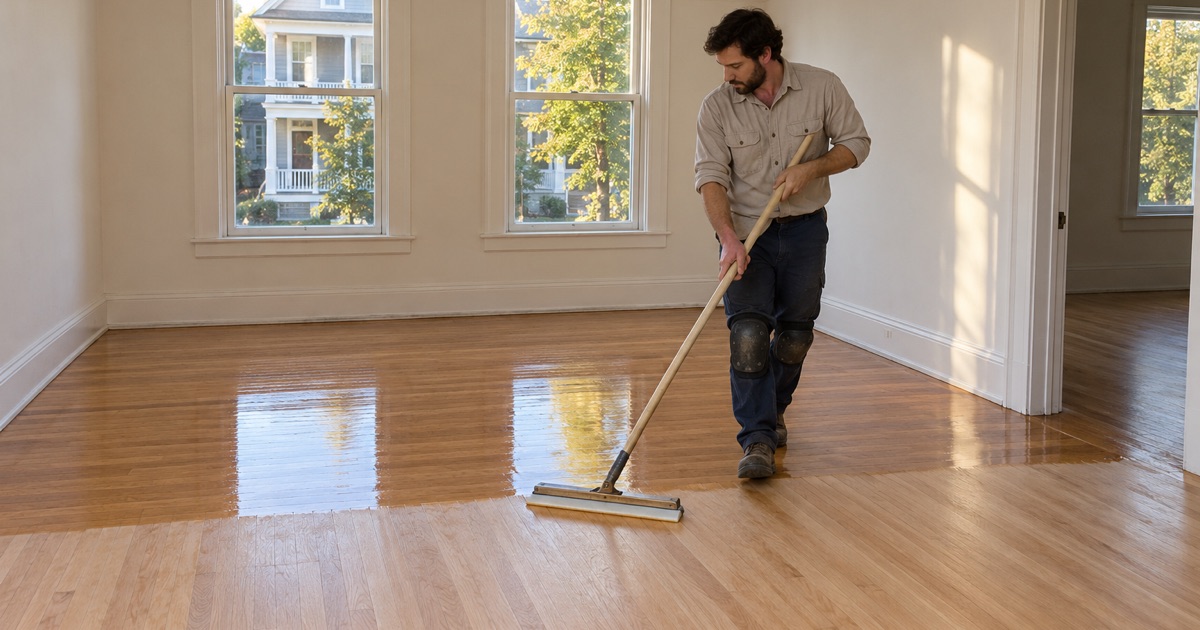
Measuring the Wood Above the Tongue
Narrow red oak strip flooring and old pine have often been sanded three, four or five times over a century. Each full sanding takes wood off the top, and once the sander reaches the tongue and groove, nail heads and splits show through and the board is finished. We lift a register or a threshold to measure what is left before choosing how aggressive the sanding can be.
When there is plenty of wood, a standard drum sander and grit sequence work fine. When it is thin, we use a lighter cut, skip the coarse grits where the floor allows, or recommend a recoat or partial replacement instead. That conversation happens before the estimate, not halfway through the job.
Testing the Old Finish for Wax and Shellac
Many old floors were finished with shellac and then waxed for decades. Wax residue soaks into the grain and stops modern polyurethane from bonding, which is why a new finish over an old waxed floor so often turns into peeling polyurethane a few months later. We test for wax and shellac before quoting, because the answer decides whether a recoat is even possible.
Lead Paint and the Build Year
Most Somerville housing was built before 1978, and painted borders, thresholds and stairs are common. Massachusetts runs its own lead law and deleading rules under 454 CMR 22.00, on top of the federal EPA RRP Rule. We check the build year and any painted surfaces before a sander goes on, and set up containment to suit what we find.
What Refinishing Fixes, and What It Does Not
Traffic Lanes, Orange Oak and Rug Shadows
Gray traffic lanes in halls and kitchens, the deep orange of an old oil finish, and the pale rug shadow where a carpet sat for years are all surface problems in the finish and the top of the wood. A full sanding removes them together and leaves the whole room one even color, which a recoat cannot do once the wood itself is worn or discolored.
Cupped Boards and Water Stains
Light cupping that has dried out and stabilized can often be sanded flat, but sanding a floor that is still wet only creates crowning once the boards dry. We read cupped areas with a moisture meter before deciding. Water stains that have turned black usually go deeper than any sander should, so those boards are replaced rather than chased.
Oak Found Under Carpet
Pulling wall-to-wall carpet in an older Somerville house very often turns up red oak strip flooring in decent shape. We remove the carpet pad, staples and tack strip, fill the nail holes along the walls, and refinish the oak, which is usually the least expensive way to get a hardwood floor into a room that has not seen one for decades.
Sanding, Repairs and Stain
Sanding to Bare Wood
The drum sander does the field of the floor, an edger works along the walls, and an orbital sander evens out the scratch pattern before finish. We step through the grit sequence rather than jumping from coarse to fine, because skipped grits leave scratches that only show once stain or finish goes on. Corners and the edges under radiators are scraped by hand.
Old pine and heart pine get a gentler sequence than oak. Softwood gouges under coarse paper and the sander can chatter across raised grain, so we sand slower and lighter, and set every protruding cut nail before the machine touches the floor.
Weave-In Repairs Before Finishing
Sanding a floor bare reveals every patch, every radiator hole and every old wall line. We fix them at this stage, cutting out damaged and stained boards and weaving in matching wood so the joints stagger the way the original floor does. A radiator hole patch done this way disappears under the finish instead of reading as a square.
Winter gaps between boards are left alone if they close in summer, because filler in a moving gap cracks out. Gaps that stay open year-round can be slip-stripped with thin wood glued into the joint.
Stain and Sheen on Your Own Floor
Stain behaves differently on red oak, white oak, maple and pine, and some red oak has a pink cast that changes how a gray or brown stain reads. Once the floor is sanded, we lay stain samples and sheen level options directly on it so you choose in your own light. A natural finish with no stain is often the best look for old oak, and we will say so.
Finishes and Living With the Work
Choosing a Finish
Waterborne polyurethane dries clear and fast, carries far less odor, and is our usual choice in an occupied building. Oil-modified polyurethane gives old oak a warmer amber tone and builds a thick film, but takes longer to dry and smells stronger. Hardwax oil soaks into the wood rather than sitting on it and can be spot-repaired, at the cost of more frequent maintenance. Every product we use fits the Massachusetts VOC limits for wood coatings under 310 CMR 7.25.
Dust Containment in a Shared House
Sanders are connected to dust collection and HEPA vacuums, and we tape plastic over doors and seal heat returns so dust stays in the unit being worked on. In a two-family or three-family house, we refinish one unit or one floor at a time so the other households keep their homes, their kitchens and their quiet.
Scheduling Stairs and Shared Hallways
Common hallway stairs are the only way in and out for upstairs units, so we refinish them in halves or on dates agreed with every household, written down in advance. Stairs inside a unit are quoted tread by tread, because each stair tread and stair nosing is hand-sanded rather than run over with a machine.
Refinishing for Landlords and Sellers
Rental Turnover Between Tenants
A vacant unit is the easiest time to refinish, and the hardest deadline. We schedule sanding and finish coats to fit the gap between one lease and the next, with a finish that is ready for move-in day. The itemized estimate records the floor’s condition and the work done, which is useful alongside the move-out paperwork Massachusetts asks a landlord to keep.
Refinishing Before a Listing
Freshly refinished oak photographs well and is one of the first things buyers notice in an old house or condo. We plan the work so the floors are cured before listing photos and showings, and steer toward a neutral stain and a satin or matte sheen that reads evenly in daylight.
- 20+ Years With Wood Floors
- Written Itemized Estimates
- Free Estimates